Resources for Cold Chain Logistics Technology Teams
Technical Documentation and Compliance Guidance for Cold Chain Operators. Reference material supporting implementation, compliance, operational planning, and software integration across refrigerated warehouses, pharmaceutical distribution centers, frozen food logistics, grocery fulfillment facilities, reefer transportation fleets, and cross-dock transfer operations.
Contact UsBrief Description of Applications
ColdChainLog AI provides technical resources that help refrigerated logistics organizations evaluate, implement, operate, and expand AI and IoT identification and location solutions. These resources support warehouse operators, transportation managers, pharmaceutical distributors, food manufacturers, logistics providers, compliance officers, IT departments, and systems integrators responsible for maintaining product integrity, operational traceability, and regulatory compliance throughout cold chain operations.
Resources That Support Cold Chain Logistics Operations
Cold chain logistics combines refrigerated warehousing, transportation, inventory management, custody transfer, regulatory compliance, and enterprise software integration into a single operational process. Every shipment may move through several facilities before reaching its destination, requiring consistent identification, accurate location records, and documented chain of custody across multiple organizations.
Implementing AI and IoT within these environments involves more than installing identification technologies. Organizations also need technical documentation, deployment guidance, implementation procedures, regulatory references, operational best practices, and integration documentation that align with existing warehouse management systems, transportation workflows, and business software.
This resource center is designed to support engineering teams, warehouse managers, logistics coordinators, IT professionals, compliance specialists, and operations executives responsible for planning or expanding AIoT-enabled cold chain logistics systems.
Reference materials throughout this page focus on practical implementation rather than product promotion. Topics include software deployment, RFID identification, BLE location services, GPS fleet visibility, middleware integration, warehouse workflows, compliance documentation, and enterprise interoperability.
Industries benefiting from these resources include:
Pharmaceutical cold storage
Vaccine distribution
Frozen food logistics
Dairy and refrigerated beverage distribution
Grocery fulfillment operations
Temperature-controlled third-party logistics
Healthcare supply chains
Biotechnology logistics
Cross-border refrigerated transportation
Multi-site cold warehouse operations
These materials are intended to reduce implementation complexity while improving consistency across warehouse facilities, transportation fleets, and enterprise software environments.
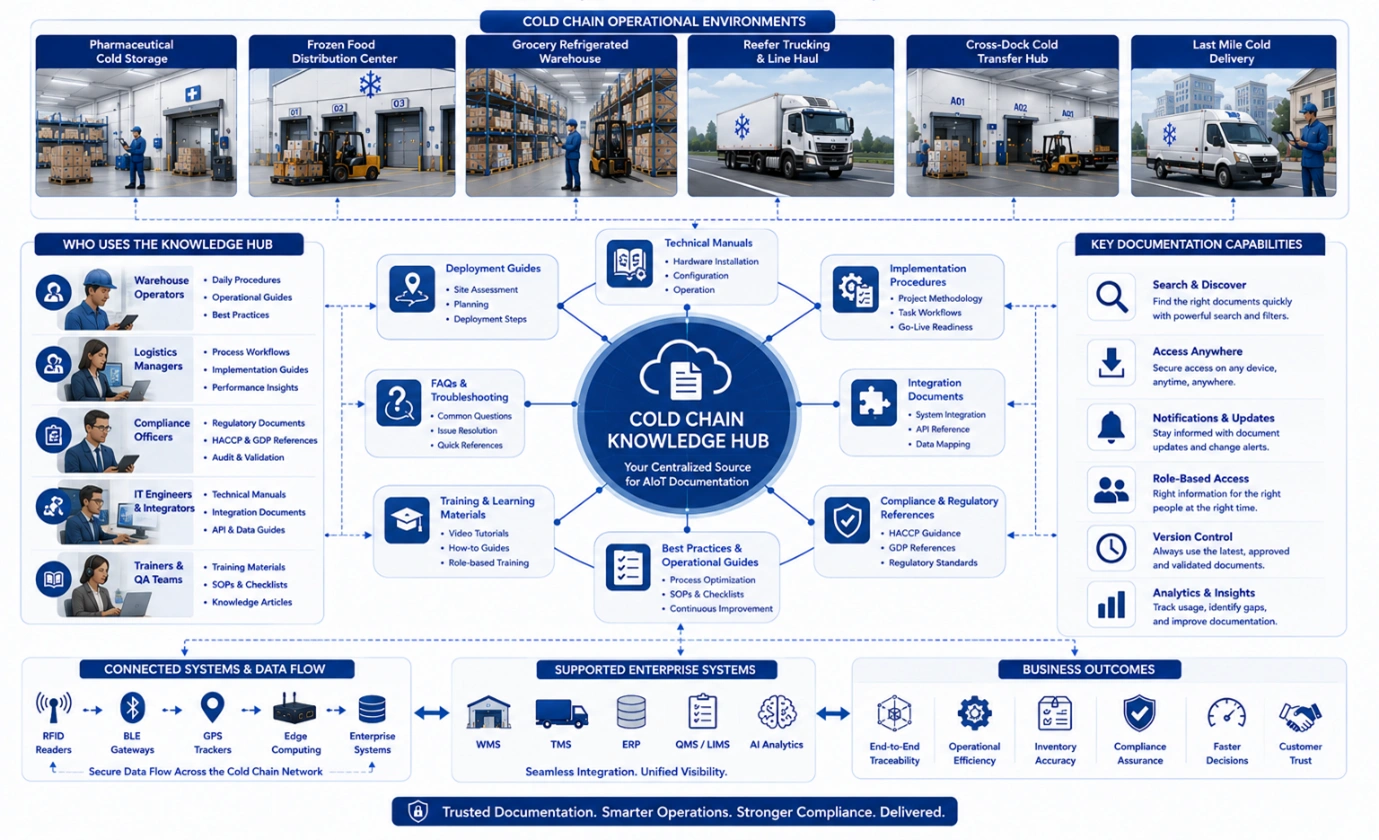
Digital Knowledge Hub for AIoT-Enabled Cold Chain Logistics Documentation and Compliance
This illustration presents a centralized digital knowledge hub that supports AIoT-enabled cold chain logistics with technical manuals, deployment guides, implementation procedures, integration documents, FAQs, HACCP guidance, GDP references, and training resources. It demonstrates how warehouse operators, logistics managers, compliance teams, and IT engineers access standardized documentation to improve implementation, regulatory compliance, operational consistency, and enterprise-wide coordination across refrigerated logistics operations.
Cold Chain Logistics Documentation
Technical documentation serves as the foundation for successful AI and IoT implementation throughout refrigerated logistics operations. Well-structured documentation allows organizations to standardize deployment practices, simplify maintenance activities, accelerate user training, and improve long-term operational consistency across multiple facilities.
Documentation also assists engineering teams during software upgrades, warehouse expansion projects, fleet modernization initiatives, and enterprise integration activities.
ColdChainLog AI organizes documentation into categories that correspond with the operational lifecycle of refrigerated logistics systems.
Implementation Documentation
Implementation documentation supports organizations during project planning and deployment.
Typical topics include:
Solution planning guidance
Warehouse readiness assessments
RFID identification planning
BLE location deployment recommendations
GPS fleet integration planning
Edge computing installation
Enterprise software connectivity
User acceptance testing
Commissioning procedures
Operational validation
These resources help implementation teams establish repeatable deployment processes while reducing project risks.
System Configuration Guides
Configuration documentation assists administrators responsible for maintaining AIoT software and connected identification infrastructure.
Typical guidance includes:
User permission management
RFID reader configuration
BLE gateway setup
GPS device registration
Warehouse zone configuration
Facility mapping
Business rule configuration
Notification management
Data synchronization settings
Security configuration
Consistent configuration practices improve software reliability while reducing administrative overhead.
Warehouse Operations Documentation
Warehouse personnel require documentation tailored to daily refrigerated operations rather than software administration alone.
Operational guides commonly address:
Receiving procedures
Pallet identification workflows
Dock verification
Inventory movement
FEFO execution
Shipment preparation
Exception handling
Custody transfer documentation
Warehouse auditing
Operational reporting
These documents help maintain standardized procedures across multiple refrigerated facilities.
Transportation Documentation
Transportation documentation focuses on reefer fleet operations from dispatch through delivery confirmation.
Reference materials typically include:
Trailer assignment
Vehicle identification
Driver authentication
Shipment loading verification
Route documentation
Custody transfer procedures
Delivery confirmation
Fleet visibility workflows
Exception reporting
Return logistics
Standardized transportation documentation improves consistency between warehouse operations and mobile logistics teams.
Enterprise Integration References
Many refrigerated logistics organizations integrate AI and IoT software with existing enterprise applications rather than replacing them.
Integration documentation commonly explains:
ERP connectivity
WMS synchronization
TMS data exchange
User authentication
API implementation
Data mapping
Event processing
Security policies
Software version compatibility
Integration testing
These resources simplify communication between warehouse systems and enterprise business software.
Maintenance Documentation
Long-term reliability depends upon documented operational maintenance procedures.
Maintenance documentation may include:
Preventive maintenance schedules
RFID equipment inspection
BLE infrastructure verification
GPS device servicing
Software update procedures
Backup management
Disaster recovery planning
Security patch management
Performance reviews
Operational health checks
Well-maintained documentation supports consistent operations while reducing unexpected downtime.
Documentation Designed for Multiple Professional Roles
Different departments interact with refrigerated logistics systems in different ways. Documentation should therefore match the responsibilities of each user group instead of providing a single generic manual.
ColdChainLog AI organizes documentation so each stakeholder can quickly locate information relevant to daily responsibilities.
Documentation categories may include:
Operations manuals for warehouse supervisors
Deployment guides for implementation teams
Configuration references for IT administrators
Integration documentation for software engineers
Compliance references for quality managers
Fleet operation guides for transportation coordinators
Training material for warehouse personnel
Executive summaries for operational leadership
Role-specific documentation improves adoption while reducing training time and operational errors.
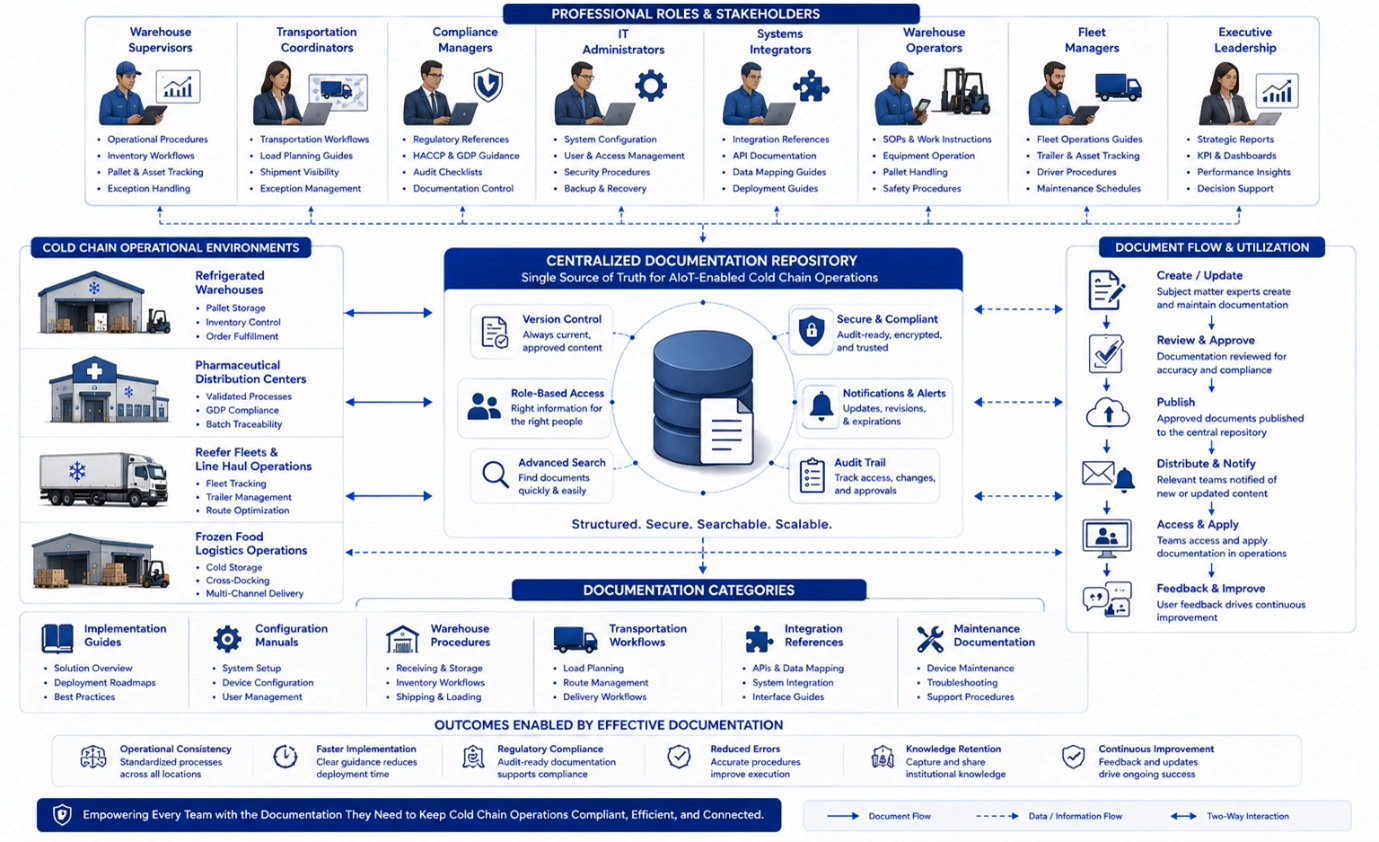
Cold Chain Logistics Documentation Workflow for Enterprise Teams
This workflow diagram illustrates how a centralized documentation repository distributes implementation guides, integration references, operational procedures, maintenance manuals, training resources, and compliance documents to multiple enterprise teams. It demonstrates how consistent technical documentation supports refrigerated warehouses, pharmaceutical distribution centers, reefer transportation, frozen food logistics, and cross-dock operations while improving operational consistency and regulatory compliance.
Cold Chain AIoT FAQs
Organizations evaluating AI and IoT for cold chain logistics often begin with practical questions related to deployment, interoperability, regulatory compliance, scalability, and operational continuity. The following frequently asked questions address common technical considerations for refrigerated warehouses, pharmaceutical distribution facilities, frozen food logistics, grocery fulfillment centers, reefer transportation fleets, and cross-dock operations.
What is AIoT in Cold Chain Logistics?
AIoT combines AI with connected industrial equipment, identification technologies, and enterprise software. Within cold chain logistics, AI and IoT primarily improves identification, location visibility, workflow automation, and operational decision support using technologies such as RFID, BLE, GPS, edge computing, and machine learning.
Rather than replacing existing warehouse or transportation software, AIoT extends operational visibility by connecting physical logistics activities with digital business processes.
How Does AI and RFID Improve Cold Chain Operations?
RFID automates the identification of pallets, containers, returnable transport items, and shipments without requiring manual barcode scanning.
Typical applications include:
Automated receiving
Dock door verification
Shipment confirmation
Warehouse inventory updates
Custody transfer recording
Trailer loading validation
Cross-dock verification
FEFO inventory execution
Automated identification reduces manual processing while improving operational accuracy across refrigerated logistics workflows.
Why Is BLE Used in Refrigerated Warehouses?
BLE supports location awareness for personnel, forklifts, mobile equipment, and operational assets within indoor environments where GPS signals may not be available.
Typical use cases include:
Worker location assistance
Restricted area management
Forklift positioning
Asset proximity detection
Personnel accountability
Emergency response coordination
Cold vault access validation
Operational zone visibility
BLE complements RFID by providing continuous location awareness for mobile resources inside warehouse facilities.
When Is Edge Computing Recommended?
Edge computing is beneficial when operational events must continue despite intermittent communication with centralized software.
Typical deployment scenarios include:
Remote distribution centers
Reefer transportation
Cross-border logistics
Cross-dock transfer facilities
Rural warehouse operations
Mobile logistics assets
High-volume dock operations
Facilities requiring rapid transaction processing
Processing events locally allows validated operational records to be synchronized automatically once communication becomes available.
Can Existing Enterprise Software Be Retained?
Yes. Many organizations continue using existing ERP, WMS, TMS, and warehouse software while integrating AI and IoT identification workflows.
Common integration objectives include:
Warehouse inventory synchronization
Transportation visibility
Shipment verification
Order fulfillment
Fleet coordination
Compliance documentation
Executive reporting
Operational analytics
This approach minimizes operational disruption while extending the capabilities of established business systems.
Which Wireless Technologies Are Commonly Used?
Cold chain logistics typically combines several communication technologies depending on operational requirements.
Common technologies include:
RFID
BLE
GPS
Cellular communications
LoRaWAN
Wi-Fi
Industrial Ethernet
Each technology supports different identification, communication, or location functions within refrigerated logistics operations.
How Can AIoT Support Multi-Facility Operations?
Organizations operating multiple refrigerated warehouses and transportation fleets require standardized information across geographically distributed locations.
AI and IoT supports these environments through:
Centralized shipment visibility
Consistent identification workflows
Unified inventory records
Fleet coordination
Warehouse synchronization
Cross-facility reporting
Standardized operational procedures
Enterprise software integration
These capabilities help maintain consistent logistics processes while supporting organizational growth.
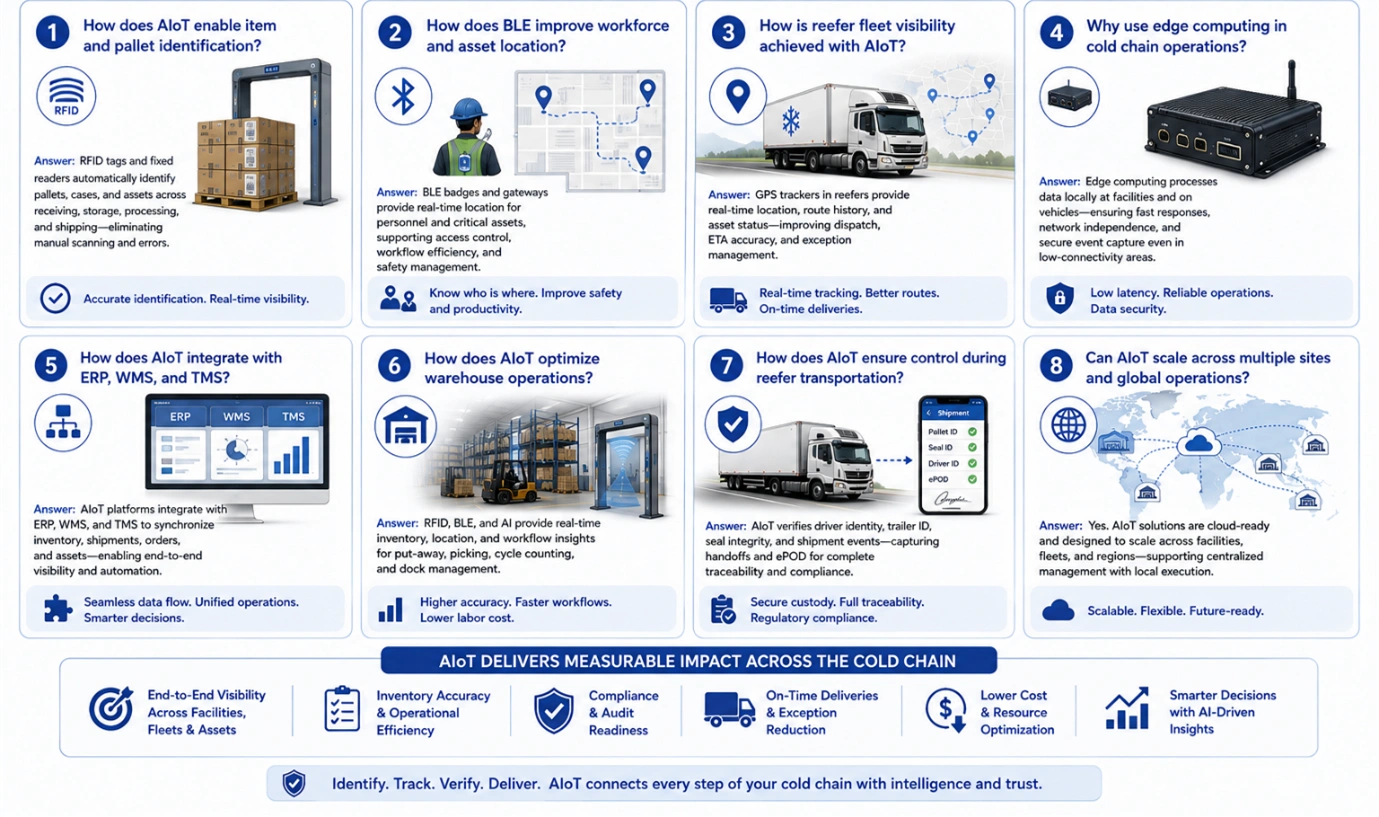
Common AIoT Questions in Cold Chain Logistics
This infographic presents the most frequently asked questions about AIoT implementation across refrigerated logistics operations. It highlights how RFID identification, BLE location services, GPS fleet tracking, edge computing, and ERP, WMS, and TMS integration improve warehouse operations, reefer transportation, traceability, scalability, and enterprise-wide operational visibility.
HACCP Compliance Guides
Hazard Analysis and Critical Control Point (HACCP) programs establish structured procedures for maintaining food safety throughout production, storage, transportation, and distribution. Refrigerated logistics organizations rely on documented operational records, product traceability, controlled warehouse procedures, and verified shipment handling to support HACCP programs.
AI and IoT identification and location solutions contribute by improving operational documentation, automating identification workflows, and supporting accurate custody records across refrigerated supply chains.
ColdChainLog AI provides guidance that helps organizations integrate identification technologies with established HACCP procedures without replacing existing quality management processes.
Identification and Product Traceability
Accurate product identification is fundamental to HACCP documentation. Every pallet, container, shipment, or batch should remain identifiable throughout receiving, storage, picking, transportation, and delivery.
Implementation guidance commonly addresses:
RFID pallet identification
Batch association
Receiving verification
Shipment validation
Warehouse movement records
Dock transaction documentation
Product recall preparation
Distribution traceability
Reliable identification simplifies investigations while supporting documented product movement.
Custody Documentation
Maintaining documented custody records is essential whenever refrigerated products move between facilities or organizations.
Reference guidance often includes:
Warehouse receiving confirmation
Internal warehouse transfers
Cross-dock handling
Vehicle loading verification
Carrier handoff documentation
Distribution center receiving
Delivery confirmation
Return logistics documentation
Consistent custody records improve accountability throughout refrigerated distribution.
Operational Procedures
Standardized operating procedures reduce variation across warehouse personnel, transportation teams, and distribution facilities.
Documentation commonly supports:
Receiving workflows
Picking procedures
Shipment staging
Loading verification
Dispatch authorization
Inventory reconciliation
Warehouse auditing
Exception management
Documented operational practices strengthen consistency while supporting HACCP compliance initiatives.
Recall Readiness
Rapid product identification becomes particularly important when organizations must isolate affected inventory during quality investigations or product recalls.
AI and IoT identification records can assist teams by supporting:
Batch identification
Distribution tracking
Shipment history
Warehouse location records
Customer shipment verification
Inventory isolation
Recall documentation
Audit preparation
Well-organized identification records improve response efficiency while minimizing unnecessary disruption.
Supporting Internal Audits
Routine internal audits help verify that warehouse procedures align with documented operating standards.
Reference materials may include guidance for:
Identification record reviews
Inventory verification
Warehouse transaction audits
Shipment reconciliation
User activity review
Access authorization verification
Operational reporting
Documentation retention
These practices contribute to stronger governance and continuous operational improvement.
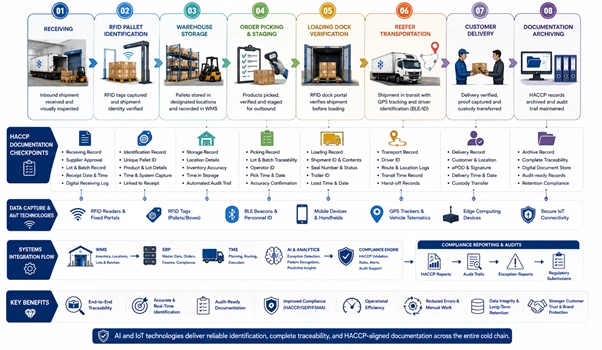
HACCP Documentation Lifecycle for AI and IoT-Enabled Cold Chain Logistics
This circular lifecycle diagram illustrates how HACCP documentation is continuously generated and validated throughout refrigerated logistics operations. It connects RFID-based identification, warehouse activities, reefer transportation, custody transfers, compliance records, and enterprise software into an audit-ready documentation process that supports traceability and regulatory compliance.
GDP Integration Guides
Good Distribution Practice (GDP) establishes quality requirements for the storage and distribution of pharmaceutical products throughout the supply chain. Organizations handling vaccines, biologics, blood products, clinical materials, specialty medicines, and temperature-sensitive pharmaceuticals must maintain documented distribution processes, verified product identification, controlled access, and complete custody records.
ColdChainLog AI supports these operational objectives by integrating AI and IoT identification and location technologies with existing warehouse software, transportation management systems, and quality management procedures. The objective is to strengthen operational visibility while preserving established GDP workflows and documentation practices.
Integrating AI and IoT with GDP Workflows
GDP implementation often requires technology to support documented procedures rather than replace them. Identification events generated through RFID, BLE, GPS, and access control systems can automatically populate business software with verified operational records.
Typical integration objectives include:
Shipment receiving verification
Pallet identification
Batch association
Warehouse transfer documentation
Vehicle loading confirmation
Delivery verification
Custody transfer recording
Authorized personnel validation
Electronic audit trail creation
Distribution reporting
These integrations reduce duplicate data entry while improving record consistency across refrigerated logistics operations.
Documentation Supporting Regulatory Reviews
Regulatory inspections frequently require organizations to demonstrate that distribution activities are documented accurately and consistently.
Reference documentation may include:
Shipment history
Warehouse transaction logs
Custody transfer records
User access history
Inventory movement reports
Vehicle dispatch documentation
Delivery confirmation records
Electronic audit trails
Batch distribution history
Operational event reports
Well-organized documentation helps simplify audit preparation and improves confidence in operational record integrity.
Maintaining Data Integrity
Reliable information is essential throughout pharmaceutical distribution. AI and IoT solutions should support validated operational records by minimizing duplicate transactions, reducing manual entry, and maintaining synchronized information across enterprise software.
Best practices include:
Consistent identification standards
Role-based user permissions
Secure communication between systems
Timestamped operational events
Automatic synchronization
Electronic change records
Backup and recovery procedures
Controlled software updates
These practices help maintain trustworthy records throughout the product distribution lifecycle.
Supporting Long-Term Compliance
Cold chain operations continue to evolve as organizations expand facilities, modernize transportation fleets, and integrate additional business software. Documentation should evolve accordingly to maintain consistent operational governance.
Organizations often establish periodic reviews covering:
Warehouse operating procedures
Integration documentation
User access policies
Software configuration records
Training documentation
Validation procedures
Business continuity planning
Compliance review schedules
Routine updates help ensure that documentation remains aligned with changing operational requirements and regulatory expectations.
Best Practices for Using Cold Chain Technical Resources
Technical documentation provides the greatest value when it becomes part of everyday operational activities rather than remaining a reference used only during implementation projects.
Recommended practices include:
Maintain a centralized documentation repository for warehouse, transportation, and IT teams.
Review operating procedures whenever software or workflow changes are introduced.
Standardize identification processes across all refrigerated facilities.
Align documentation with ERP, WMS, and TMS integration updates.
Conduct periodic training using current operating guides.
Retain version-controlled deployment and configuration records.
Perform scheduled reviews of compliance documentation.
Include implementation lessons learned in future project documentation.
Verify documentation accuracy following major software upgrades.
Encourage collaboration between operations, engineering, quality assurance, and IT personnel.
Following these practices helps organizations improve operational consistency while supporting long-term system reliability and regulatory readiness.
Why Comprehensive Technical Resources Matter
Successful AI and IoT adoption depends on more than hardware installation or software deployment. Sustainable success requires consistent documentation, standardized operating procedures, integration guidance, compliance references, and practical knowledge that supports every stage of refrigerated logistics.
ColdChainLog AI organizes technical resources to help warehouse operators, transportation providers, pharmaceutical distributors, frozen food logistics companies, grocery fulfillment organizations, and healthcare supply chains make informed implementation and operational decisions.
Whether planning a new deployment or expanding an existing solution, structured documentation helps reduce implementation risk, improve user adoption, simplify enterprise integration, and maintain accurate identification records across warehouses, distribution centers, reefer fleets, and cross-dock operations.
About ColdChainLog AI
ColdChainLog AI was established within Aperture Venture Studio with support from GAO, drawing on more than two decades of IoT experience across industrial logistics and refrigerated supply chain operations. The knowledge reflected throughout these technical resources is informed by thousands of completed IoT projects and deployments serving organizations with diverse operational requirements.
Research and development investments, comprehensive quality assurance processes, and remote as well as onsite technical support contribute to documentation that emphasizes practical implementation guidance. The organization is led by Ph.D. professionals from leading universities and works alongside experienced technical specialists and strategic partners.
Over the years, experience gained while supporting Fortune 500 companies, leading research institutions, universities, and government agencies in the United States and Canada has contributed to a broad understanding of enterprise AI and IoT deployment, identification technologies, software integration, and operational best practices applicable to refrigerated logistics.
Supporting Successful Cold Chain AIoT Implementation
Reliable cold chain logistics depends on accurate identification, consistent documentation, standardized operational procedures, and well-integrated business software. Technical resources play an important role throughout planning, deployment, daily operations, compliance activities, and future expansion.
ColdChainLog AI provides documentation, implementation guidance, technical references, frequently asked questions, HACCP resources, and GDP integration guidance that help organizations strengthen refrigerated warehouse operations, reefer transportation, pharmaceutical distribution, frozen food logistics, and grocery fulfillment networks. By combining practical implementation knowledge with enterprise AI and IoT technologies focused on identification and location solutions, organizations can improve operational visibility, maintain reliable business records, and support long-term compliance objectives across the entire cold chain.
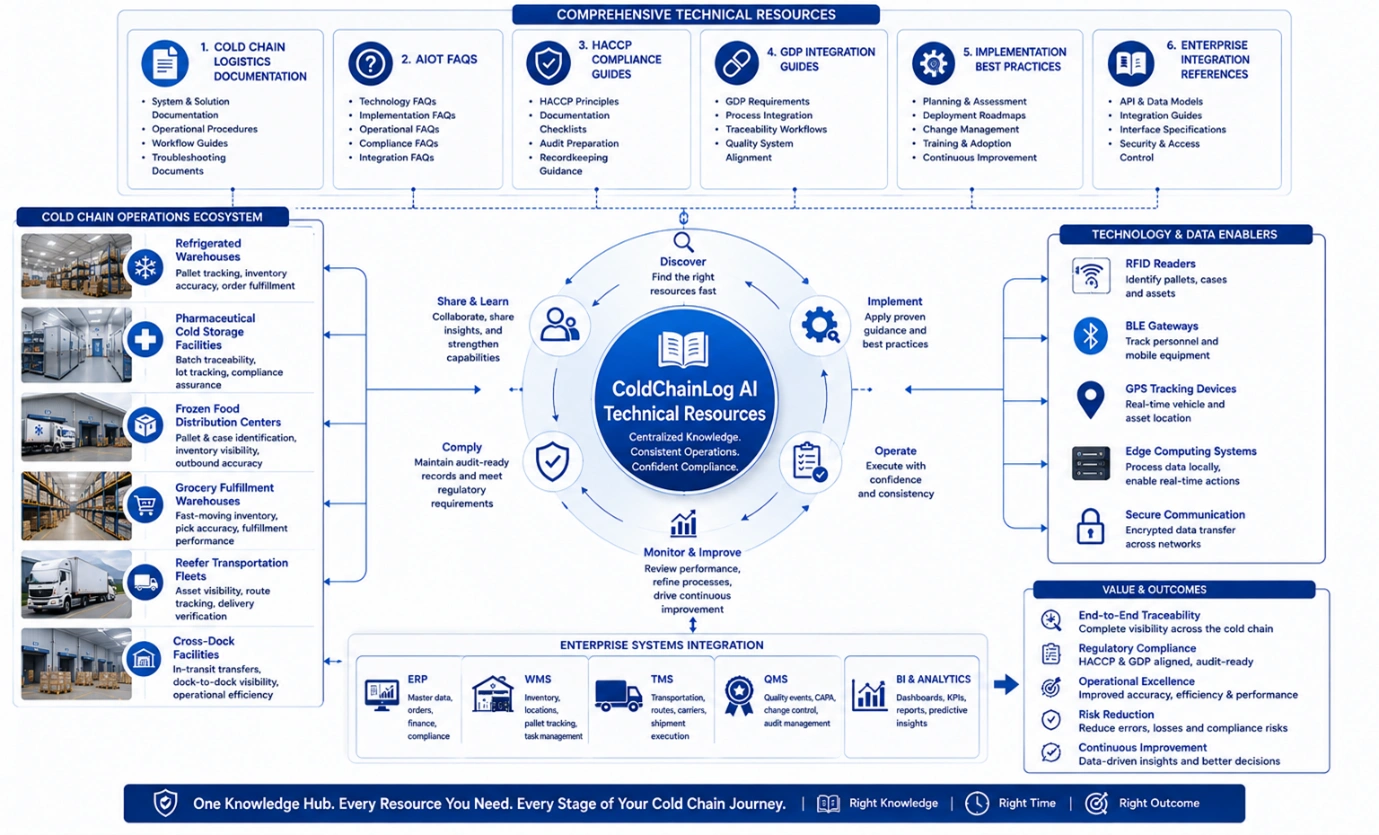
ColdChainLog AI Technical Resources Knowledge Hub for AIoT-Enabled Cold Chain Logistics
This knowledge hub diagram illustrates how ColdChainLog AI technical resources support every phase of AIoT-enabled cold chain logistics, from planning and implementation to operations, compliance, and continuous improvement. It shows the relationships between documentation, enterprise software, identification technologies, and refrigerated logistics environments, highlighting how knowledge sharing strengthens traceability, interoperability, regulatory compliance, and operational performance.