Real-World Applications of AIoT in Cold Chain Logistics
ColdChainLog AI applies AI and IoT, RFID, BLE, GPS, edge computing, and enterprise software integration across refrigerated warehouses, reefer fleets, pharmaceutical distribution, frozen food logistics, and temperature-controlled transportation to improve workforce visibility, access management, asset identification, inventory accuracy, traceability, and operational coordination.
Contact UsAIoT Applications Across Cold Chain Logistics Operations
Cold chain logistics encompasses numerous operational environments, each presenting distinct workflows, compliance obligations, transportation requirements, and product handling procedures. Pharmaceutical products, vaccines, frozen foods, fresh produce, biologics, dairy products, seafood, and other temperature-sensitive goods move through refrigerated warehouses, cross-dock terminals, blast freezers, reefer trailers, and regional distribution centers before reaching healthcare providers, retailers, foodservice organizations, and consumers.
Rather than applying one generic AI and IoT solution across every operation, ColdChainLog AI tailors identification and location technologies to the unique requirements of each cold chain environment. AI and RFID, AI and BLE, GPS tracking, secure access control, enterprise software integration, and edge computing are implemented according to operational workflows, regulatory obligations, and logistics processes specific to refrigerated transportation and storage.
This page highlights representative application areas where AIoT supports people tracking, facility access, asset tracking, inventory management, work-in-progress visibility, traceability, and cold chain operations across industrial logistics and supply chain environments.
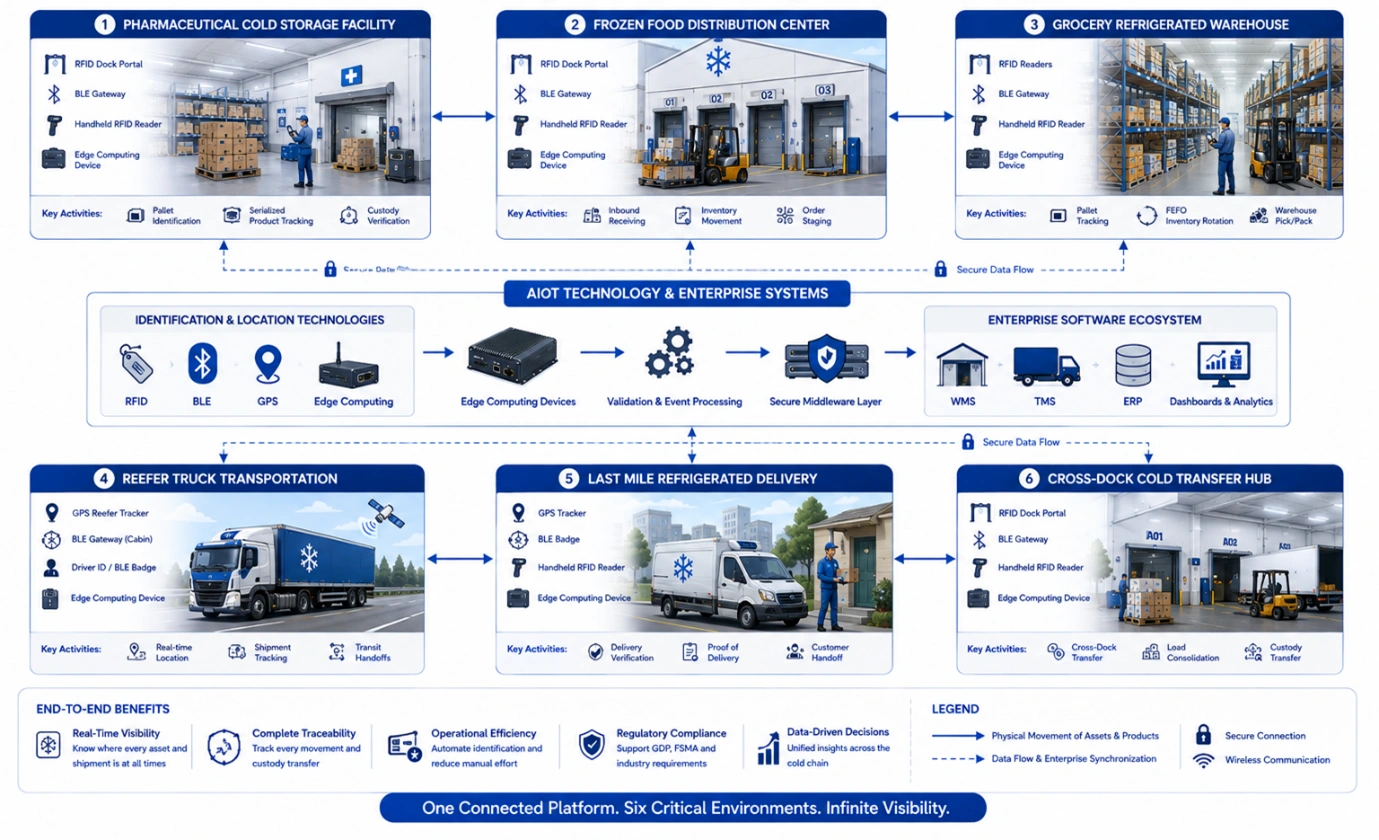
Shows how AIoT supports pharmaceutical cold storage, frozen food distribution, grocery refrigerated warehousing, reefer transportation, last mile refrigerated delivery, and cross-dock transfer operations within a connected logistics network. The illustration highlights identification workflows, asset movement, custody transfer, and synchronized data exchange between RFID, BLE, GPS, edge computing, WMS, TMS, ERP, and enterprise business systems.
Pharmaceutical Cold Storage Facilities
Pharmaceutical cold storage facilities represent one of the most demanding environments within cold chain logistics. Vaccines, biologics, blood products, specialty medications, clinical trial materials, and temperature-controlled pharmaceuticals require strict custody management, documented handling procedures, authorized personnel access, and complete product traceability throughout storage and distribution.
AI and IoT solutions support these operations by improving identification accuracy and operational visibility rather than replacing existing quality procedures. RFID identification, BLE location awareness, secure credential verification, GPS shipment tracking, and enterprise software integration allow healthcare logistics organizations to maintain accurate movement records while supporting regulatory compliance and inventory accountability.
Typical pharmaceutical logistics activities include:
Controlled warehouse receiving
Pallet identification
Batch verification
Secure vault access
Authorized personnel validation
Cold room inventory movement
Distribution staging
Shipment custody transfer
Pharmaceutical returns processing
Regional distribution coordination
Identification events generated throughout these workflows are synchronized with warehouse management software, enterprise resource planning systems, transportation management software, and regulatory documentation systems to maintain complete operational records.
People tracking is particularly valuable inside pharmaceutical cold storage operations where only authorized personnel should enter restricted storage areas containing controlled medications, vaccines, biologics, or investigational products. BLE identification badges, RFID credentials, and access control software help verify personnel movement while maintaining audit-ready activity logs.
Asset tracking supports visibility of refrigerated containers, insulated shipping boxes, mobile storage racks, pharmaceutical carts, reusable transport containers, and returnable packaging assets as they move through receiving, storage, order fulfillment, and outbound shipping.
Inventory identification also becomes significantly more efficient through RFID-enabled pallet verification and AI-assisted inventory reconciliation. Instead of relying exclusively on manual barcode scanning, warehouse personnel can rapidly confirm pallet identity, shipment composition, and storage assignments while reducing administrative effort.
Organizations operating pharmaceutical cold storage facilities also benefit from work-in-progress visibility during order preparation. Distribution managers can identify pallet staging status, shipment readiness, packaging progression, and outbound loading activities without interrupting warehouse workflows.
Cold chain traceability remains essential throughout pharmaceutical logistics. Complete electronic custody records support product authentication, recall readiness, regulatory reporting, and chain-of-custody documentation from manufacturer through distribution.
ColdChainLog AI supports these operational requirements through enterprise AIoT solutions designed specifically for refrigerated pharmaceutical logistics, integrating identification technologies with existing warehouse and transportation software while minimizing operational disruption.
Frozen Food Distribution Centers
Frozen food distribution centers process large volumes of packaged foods, meat products, seafood, prepared meals, vegetables, dairy products, bakery products, desserts, and frozen ingredients moving through regional and national distribution networks.
Operational efficiency depends on accurate identification of workers, forklifts, pallets, storage locations, outbound trailers, and loading dock activities across freezer warehouses operating continuously under demanding environmental conditions.
AI and RFID and AI and BLE solutions improve operational coordination by providing real-time visibility of identification events throughout warehouse activities. Rather than relying exclusively on manual scanning, automated RFID portal reads, BLE location services, GPS fleet tracking, and warehouse software synchronization improve inventory accuracy while supporting high-volume logistics operations.
Common operational workflows include:
Trailer receiving
Dock assignment
Forklift identification
Pallet verification
Rack storage allocation
FEFO inventory rotation
Frozen order picking
Shipment consolidation
Trailer loading
Distribution dispatch
Access control also plays an important role in freezer environments where blast freezers, refrigerated storage rooms, loading docks, and controlled operational areas require authorization based on employee responsibilities.
AI-enabled access verification can support:
Restricted freezer entry
Forklift operator authorization
Visitor management
Contractor access
Dock door credential verification
Loading bay security
Shift-based authorization
Temporary maintenance access
Asset tracking enhances utilization of refrigerated trailers, forklifts, pallet pools, mobile racks, reusable shipping containers, and material handling equipment. Warehouse managers gain improved visibility into asset locations, movement history, dwell times, and equipment availability without increasing manual administrative work.
Inventory operations also benefit from AI-assisted RFID identification supporting:
Faster receiving verification
Automated pallet confirmation
Warehouse slot validation
Inventory reconciliation
Outbound shipment verification
Distribution accuracy
Cross-shift inventory consistency
Electronic shipment documentation
ColdChainLog AI supports frozen food logistics organizations by integrating AI and IoT identification workflows with warehouse management software, transportation systems, enterprise business applications, and refrigerated distribution operations. These deployments help improve operational coordination while maintaining reliable identification records across freezer warehouses, refrigerated loading docks, and regional frozen food distribution centers.
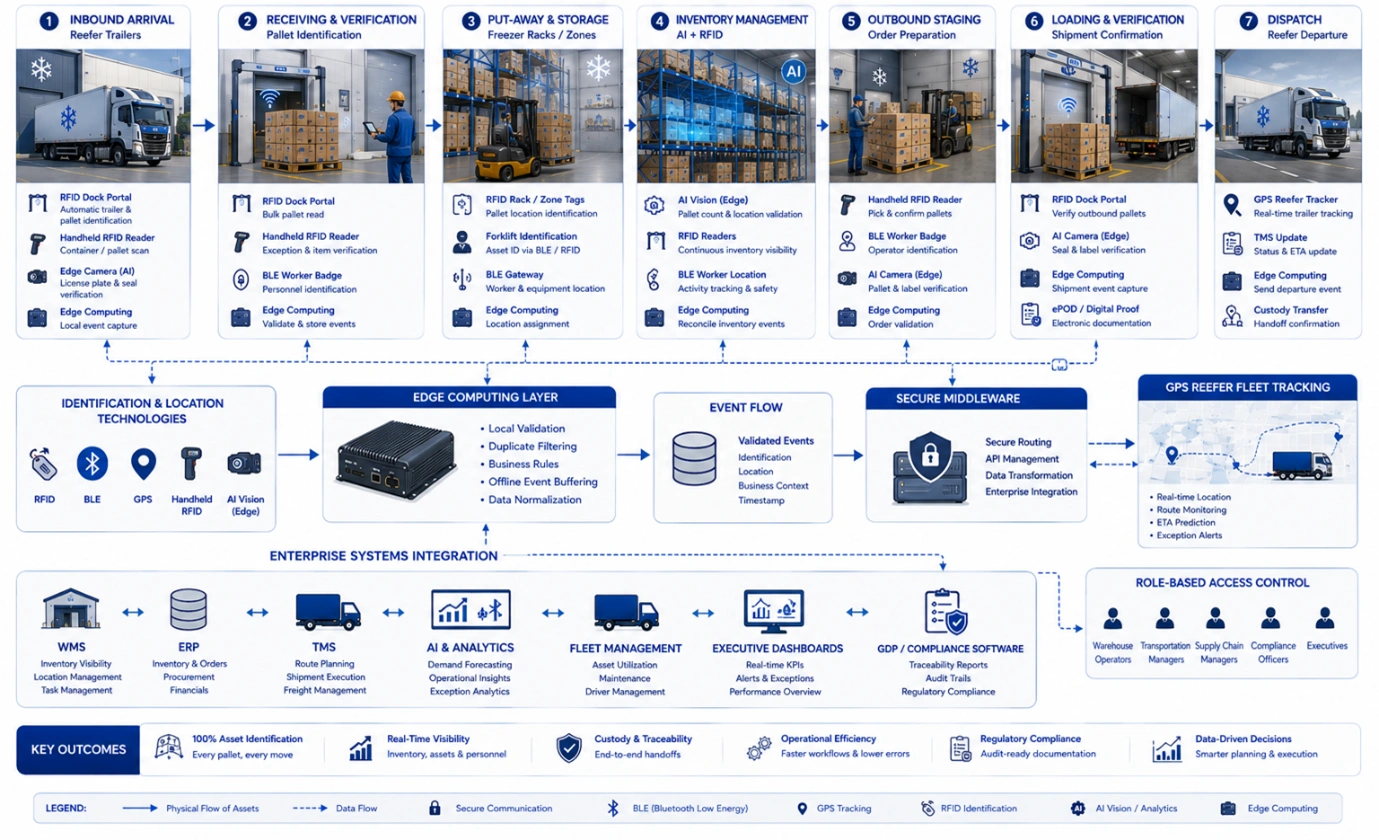
AIoT Workflow for Frozen Food Distribution Center Operations
Illustrates how frozen food distribution centers use RFID pallet identification, BLE worker credentials, GPS reefer tracking, and edge computing to coordinate receiving, storage, inventory management, outbound staging, shipment verification, and dispatch. The workflow highlights synchronized data exchange with WMS, ERP, TMS, compliance software, and executive dashboards to improve inventory accuracy, asset visibility, shipment traceability, and operational efficiency.
Perishable Grocery Cold Warehousing
Perishable grocery cold warehousing supports continuous replenishment of supermarkets, wholesale distributors, convenience stores, foodservice providers, and retail fulfillment centers. Fresh produce, dairy products, meat, poultry, seafood, ready-to-eat meals, and refrigerated packaged foods move rapidly through receiving, storage, order picking, consolidation, and outbound shipping. Product freshness, inventory rotation, and shipment accuracy are equally important because inventory turnover is significantly higher than in many other refrigerated logistics operations.
ColdChainLog AI applies AI and IoT solutions to improve operational visibility across these high-throughput facilities. Rather than focusing solely on environmental measurements, the solution emphasizes identification and location workflows using RFID, BLE, GPS, edge computing, and enterprise software integration.
Typical operational activities include:
Receiving inbound refrigerated shipments
Dock assignment verification
RFID pallet identification
Cold room storage allocation
FEFO inventory rotation
Grocery order picking
Mixed pallet consolidation
Retail shipment verification
Cross-dock transfers
Outbound dispatch
People tracking helps distribution managers understand workforce movement across refrigerated storage zones, staging lanes, loading docks, and order fulfillment areas. BLE badges and secure credential verification improve workforce visibility while supporting operational safety and controlled access to restricted cold rooms.
Access control systems strengthen warehouse security by validating personnel authorization before entry into refrigerated storage areas, pharmaceutical holding rooms, high-value inventory zones, and restricted loading bays. Access events are recorded automatically to simplify operational auditing and regulatory documentation.
Asset tracking improves utilization of reusable pallets, roll cages, insulated containers, forklifts, pallet jacks, refrigerated carts, and warehouse handling equipment. AI-assisted software identifies equipment locations, utilization patterns, dwell times, and movement history to improve operational planning without increasing manual reporting requirements.
Inventory management benefits from AI and RFID identification by supporting rapid pallet verification, warehouse slot confirmation, shipment validation, and electronic inventory reconciliation. Warehouse personnel can process larger shipment volumes while reducing manual barcode scanning and administrative effort.
Traceability remains a core requirement throughout grocery cold logistics. Electronic custody records document product movement from receiving through storage, order preparation, loading, and retail distribution, supporting food safety investigations, recall management, and inventory accountability.
ColdChainLog AI integrates these operational workflows with warehouse management software, ERP systems, transportation management software, and enterprise reporting systems, providing consistent identification records across grocery cold warehousing operations.
Reefer Trucking and Line Haul
Temperature-controlled transportation connects manufacturers, refrigerated warehouses, pharmaceutical distribution centers, ports, airports, grocery distribution facilities, and retail networks. Reefer trailers, refrigerated straight trucks, intermodal refrigerated containers, and specialized cold transport fleets operate across regional, national, and cross-border logistics routes where continuous shipment visibility is essential.
AI and IoT supports these transportation operations by combining RFID identification, BLE location services, GPS fleet tracking, edge computing, and enterprise software synchronization. These technologies provide reliable identification and location information while maintaining continuity during long-distance transportation.
Representative transportation workflows include:
Trailer dispatch
Vehicle identification
Driver authentication
Shipment loading confirmation
Distribution route assignment
Custody transfer recording
Yard arrival verification
Delivery confirmation
Empty trailer recovery
Fleet utilization reporting
GPS tracking provides continuous visibility into trailer locations, while RFID verification confirms shipment identity during loading and unloading activities. BLE-based personnel identification assists with driver authentication, authorized vehicle access, and transportation workflow management.
People tracking also supports dispatch operations by confirming authorized personnel involvement during trailer loading, shipment release, and custody transfer activities. Access records help transportation managers maintain operational accountability throughout distribution networks.
Asset tracking extends beyond trailers to include refrigerated containers, insulated shipping units, reusable transport equipment, mobile refrigeration assets, and specialized cargo handling equipment. AI-assisted analytics improve fleet utilization, reduce idle equipment, and simplify equipment allocation across multiple logistics facilities.
Enterprise software synchronization ensures transportation events are automatically shared with transportation management software, warehouse management systems, ERP applications, and customer shipment records. Edge computing validates identification events locally before forwarding approved transactions, reducing duplicate records and improving enterprise data quality.
ColdChainLog AI supports reefer transportation organizations by integrating identification and location workflows across fleet operations, warehouse systems, and distribution software while maintaining operational continuity during regional and long-distance refrigerated transportation.
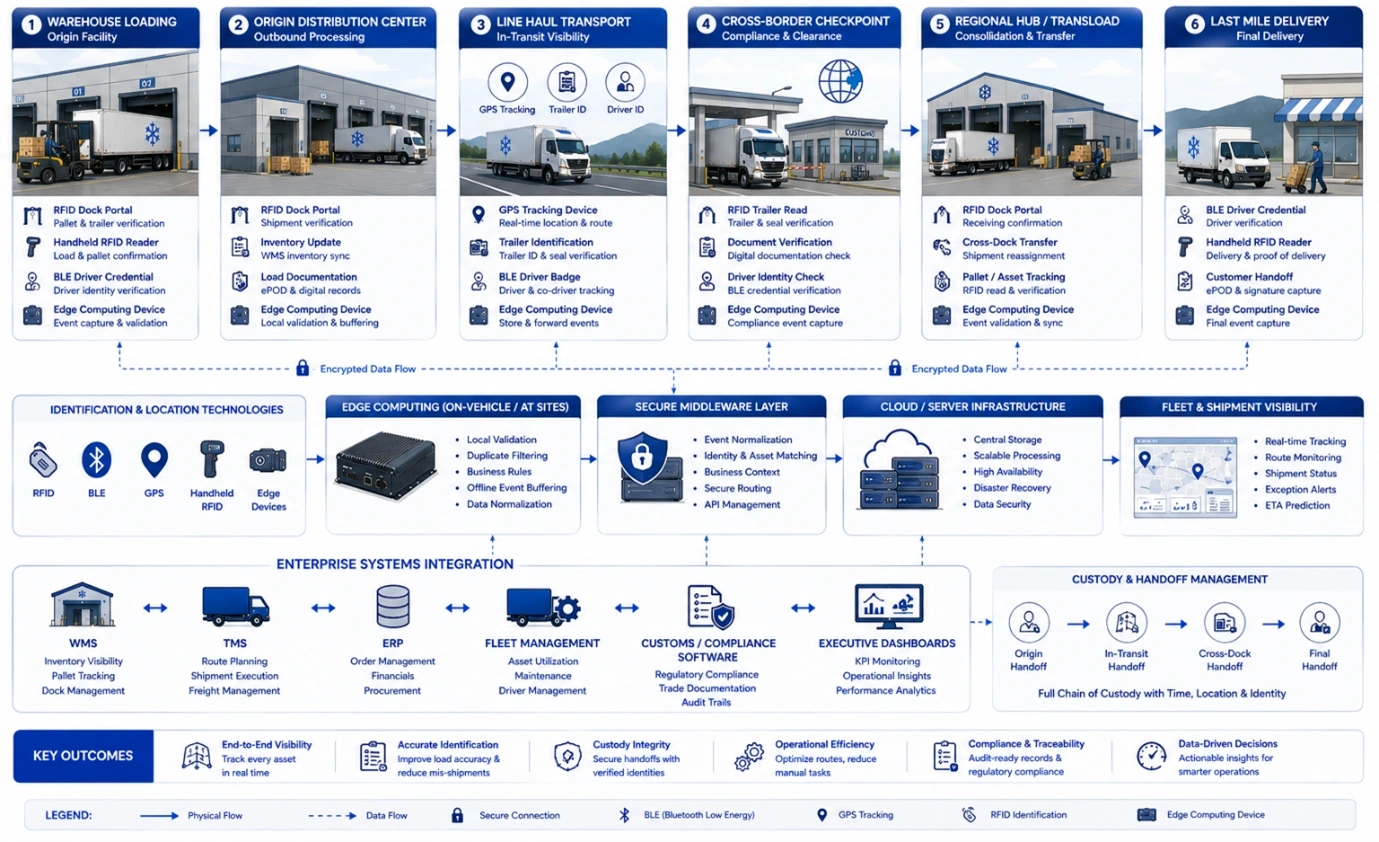
AI and IoT Workflow for Refrigerated Transportation and Line Haul Operations
This workflow diagram illustrates how refrigerated shipments move from warehouse loading through regional transportation and final delivery using AI and IoT identification and location technologies. It highlights RFID-based shipment verification, BLE driver identification, GPS-enabled reefer tracking, custody transfer, edge computing, and synchronized communication with WMS, ERP, and TMS to improve asset visibility and transportation coordination across cold chain logistics.
Last Mile Cold Delivery
Last mile cold delivery represents the final stage of refrigerated logistics, where pharmaceuticals, vaccines, meal kits, grocery orders, specialty foods, biologics, floral products, and other temperature-controlled goods are delivered directly to hospitals, pharmacies, retail stores, restaurants, laboratories, healthcare facilities, and consumers. Delivery accuracy, custody verification, and shipment traceability become increasingly important because products often move through multiple transfer points before reaching their final destination.
ColdChainLog AI applies AI and IoT technologies to strengthen identification, location visibility, and operational coordination throughout last mile delivery. RFID shipment verification, BLE personnel identification, GPS vehicle tracking, secure access management, and enterprise software integration support reliable delivery operations while reducing manual documentation.
Common operational workflows include:
Vehicle dispatch
Driver authentication
Shipment verification
Route assignment
Delivery scheduling
Customer handoff confirmation
Electronic proof of delivery
Return logistics processing
Delivery exception handling
Fleet utilization reporting
People tracking assists delivery organizations by confirming authorized drivers, warehouse dispatch personnel, and receiving staff involved in shipment transfers. Secure identification records simplify operational audits and chain-of-custody documentation.
Access control supports restricted delivery environments such as hospitals, pharmaceutical facilities, research laboratories, healthcare campuses, and secure distribution locations where authorized entry must be validated before deliveries are completed.
Asset tracking improves visibility of insulated delivery containers, reusable transport boxes, handheld RFID devices, mobile refrigeration units, returnable packaging, and delivery vehicles. Fleet managers can identify equipment availability, movement history, and return cycles while improving equipment utilization.
Enterprise synchronization connects delivery events with warehouse management software, transportation systems, ERP applications, customer order software, and electronic documentation systems. Delivery confirmations, custody transfers, shipment verification, and return processing records are automatically synchronized, reducing administrative effort while improving operational accuracy.
ColdChainLog AI helps organizations maintain reliable identification records and coordinated logistics workflows across the final stage of refrigerated distribution, supporting efficient delivery operations throughout complex cold chain networks.
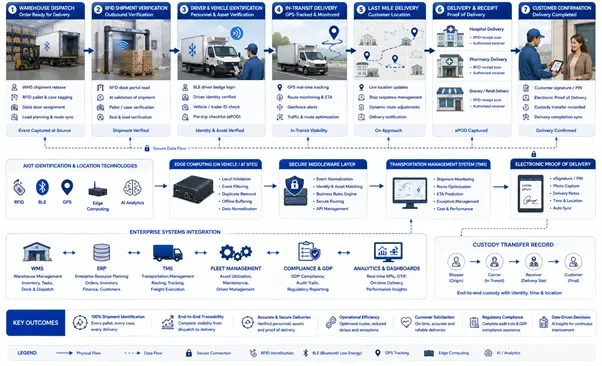
AIoT-Enabled Last Mile Cold Delivery Workflow for End-to-End Shipment Identification and Traceability
This diagram illustrates the end-to-end refrigerated delivery workflow from warehouse dispatch to final customer receipt using AI and IoT technologies. It highlights RFID shipment verification, BLE driver identification, GPS-tracked refrigerated vehicles, electronic proof of delivery, custody transfer, and synchronized integration with WMS, TMS, ERP, and compliance systems to improve traceability, asset visibility, and delivery verification across cold chain logistics.
Cross Dock Cold Transfer Hubs
Cross-dock cold transfer hubs are designed to move refrigerated shipments rapidly between inbound and outbound transportation with minimal storage time. These facilities support pharmaceutical distribution, grocery replenishment, frozen food logistics, foodservice distribution, and regional transportation networks where shipment velocity is often more important than long-term storage.
Because products may remain inside the facility only briefly, accurate identification, shipment verification, personnel coordination, and synchronized logistics records become essential. ColdChainLog AI applies AI and IoT technologies to improve visibility across these fast-moving operations while integrating with existing warehouse, transportation, and enterprise software.
Typical operational workflows include:
Inbound trailer verification
Dock door assignment
RFID pallet identification
Shipment sorting
Cross-dock staging
Outbound trailer allocation
Custody transfer documentation
Dispatch confirmation
Returnable asset tracking
Electronic shipment reconciliation
People tracking supports workforce coordination across receiving docks, staging lanes, outbound loading areas, and secure transfer zones. BLE identification badges and controlled access credentials help verify authorized personnel participating in shipment handling while maintaining electronic activity records.
Access control reduces operational risk by restricting entry to refrigerated transfer areas, pharmaceutical staging rooms, outbound loading docks, and secure logistics zones. Access events are automatically recorded to support compliance documentation and operational auditing.
Asset tracking improves visibility of pallets, reusable containers, forklifts, pallet jacks, refrigerated trailers, and mobile handling equipment moving continuously between loading operations. AI-assisted software helps logistics managers identify equipment availability, optimize utilization, and reduce delays associated with misplaced assets.
Inventory identification remains important even though inventory dwell times are relatively short. RFID verification supports rapid shipment confirmation during receiving and outbound loading, while enterprise software automatically synchronizes shipment records with warehouse management systems, transportation management software, and ERP applications.
Traceability continues throughout every custody transfer. Electronic records provide complete shipment histories from inbound receipt through outbound dispatch, supporting recall readiness, regulatory reporting, customer documentation, and supply chain transparency.
ColdChainLog AI enables cross-dock facilities to coordinate identification, asset visibility, access management, and enterprise synchronization without disrupting the rapid operational pace required in refrigerated logistics.
Why AIoT Applications Differ Across Cold Chain Logistics
Every refrigerated logistics operation has unique business priorities, regulatory obligations, operational workflows, and transportation requirements. Although pharmaceutical warehouses, frozen food distribution centers, grocery fulfillment facilities, reefer transportation fleets, and cross-dock hubs all operate within cold chain logistics, each environment requires a different combination of identification, location, software integration, and operational automation.
ColdChainLog AI adapts AI and IoT deployments according to operational requirements rather than applying identical solutions across every facility.
Examples include:
Pharmaceutical logistics emphasizing regulatory traceability, controlled access, electronic custody documentation, and authenticated personnel verification.
Frozen food distribution focusing on high-volume pallet movement, forklift coordination, FEFO inventory rotation, and warehouse throughput.
Grocery cold warehousing prioritizing rapid inventory turnover, retail replenishment, mixed-load fulfillment, and shipment verification.
Reefer transportation requiring continuous fleet visibility, trailer identification, driver authentication, and synchronized transportation records.
Last mile delivery emphasizing delivery confirmation, proof of custody, authorized access, and customer handoff documentation.
Cross-dock transfer hubs focusing on shipment routing, rapid pallet verification, dock coordination, and real-time logistics synchronization.
This operational specialization allows organizations to improve visibility, maintain accurate identification records, and integrate existing enterprise software without introducing unnecessary operational complexity.
Industry Applications Summary
ColdChainLog AI supports a broad range of refrigerated logistics organizations throughout Industrial Logistics & Supply Chain operations.
Representative application areas include:
Pharmaceutical cold storage facilities
Vaccine distribution centers
Biologics and biotechnology logistics
Frozen food distribution warehouses
Meat and poultry processing distribution
Dairy product logistics
Seafood distribution operations
Fresh produce cold warehousing
Grocery fulfillment centers
Retail distribution facilities
Refrigerated third-party logistics providers
Reefer fleet operations
Regional refrigerated transportation
Cross-border cold logistics
Last mile refrigerated delivery
Cross-dock cold transfer hubs
Airport pharmaceutical logistics
Port refrigerated cargo terminals
Foodservice distribution networks
Healthcare logistics operations
Each deployment combines AI and IoT software, RFID identification, BLE location services, GPS fleet visibility, edge computing, and enterprise integration according to the operational objectives of the organization while emphasizing identification, location awareness, inventory accuracy, traceability, and business continuity.
Advancing Cold Chain Logistics with AI and IoT Solutions
Reliable cold chain logistics depends on far more than maintaining temperature-controlled transportation and storage. Every shipment, pallet, vehicle, worker, dock door, warehouse location, and custody transfer must be accurately identified, securely documented, and consistently synchronized across enterprise software to support efficient operations.
ColdChainLog AI provides AI and IoT solutions that connect identification technologies, asset tracking, access management, inventory visibility, traceability, and enterprise software across refrigerated logistics operations. Rather than replacing existing warehouse or transportation systems, these solutions integrate with established business processes to improve operational coordination, data quality, and decision making.
Whether supporting pharmaceutical distribution, frozen food logistics, grocery fulfillment, reefer transportation, or cross-dock transfer facilities, ColdChainLog AI helps organizations strengthen operational visibility while maintaining reliable, scalable, and secure refrigerated logistics workflows.
Why Organizations Choose ColdChainLog AI
ColdChainLog AI was created within Aperture Venture Studio, with support from GAO, drawing upon more than two decades of practical IoT implementation experience across Industrial Logistics & Supply Chain operations.
Our solutions are built upon knowledge gained from thousands of completed IoT projects and deployments serving refrigerated warehousing, transportation, asset identification, inventory management, and enterprise integration requirements.
Organizations benefit from:
Extensive experience supporting refrigerated logistics operations
Proven expertise integrating AI and IoT with enterprise software
Strong research and development supported by rigorous quality assurance
Remote and onsite technical support provided by experienced engineering teams
Leadership from Ph.D. professionals and industry specialists
Experience supporting Fortune 500 companies, leading research organizations, prestigious universities, and government agencies throughout the United States and Canada
Practical implementation methodologies based on real operational environments rather than theoretical concepts
This combination of technical expertise and deployment experience enables ColdChainLog AI to deliver enterprise AIoT solutions that align with existing refrigerated logistics workflows while supporting long-term operational growth.
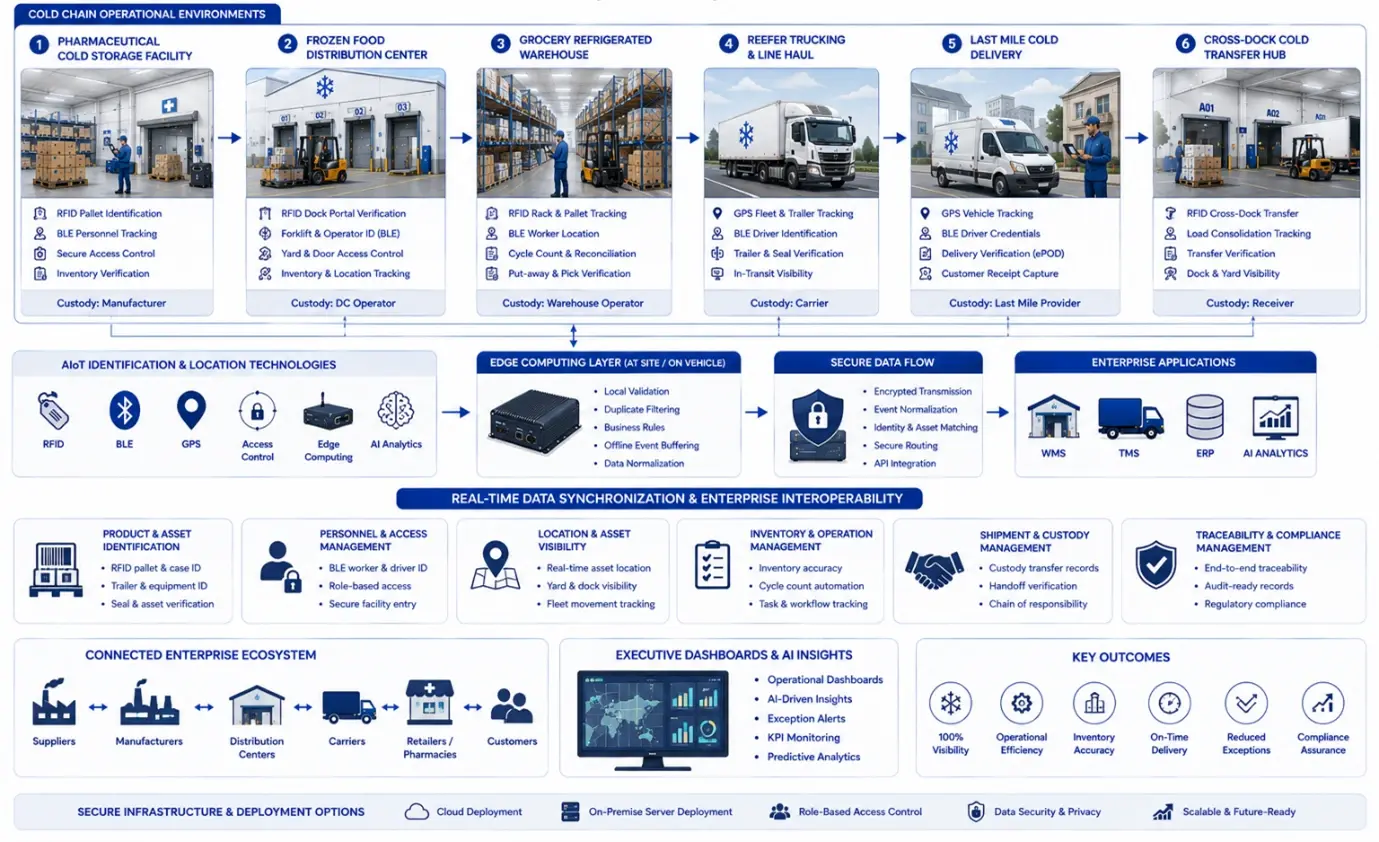
AIoT-Enabled Cold Chain Logistics: End-to-End Enterprise Operations Across Refrigerated Supply Networks
This enterprise illustration summarizes how AI and IoT supports the complete refrigerated logistics lifecycle, connecting pharmaceutical cold storage, frozen food distribution, grocery warehouses, reefer transportation, last mile delivery, and cross-dock operations. It demonstrates how RFID identification, BLE personnel tracking, GPS fleet visibility, edge computing, and enterprise software integration enable synchronized asset tracking, inventory verification, custody transfer, traceability, and operational coordination across the cold chain.