
System Integration for AIoT-Enabled Cold Chain Logistics
Middleware, edge computing, and flexible deployment models connecting refrigerated warehouses, reefer fleets, distribution centers, and enterprise business software throughout cold chain logistics operations.
Contact UsApplications in Cold Chain Logistics
ColdChainLog AI develops AI and IoT integration solutions specifically for refrigerated logistics operations where products continuously move between production facilities, pharmaceutical warehouses, frozen food distribution centers, refrigerated transportation networks, cross-dock terminals, and retail fulfillment locations.
Typical deployment environments include:
Pharmaceutical cold storage facilities
Vaccine distribution centers
Frozen food warehouses
Meat and seafood distribution
Dairy logistics operations
Produce distribution centers
Multi-temperature cold storage
Refrigerated cross-dock facilities
Reefer trailer fleets
Last-mile refrigerated delivery
Grocery distribution centers
Healthcare logistics
Airport pharmaceutical cargo terminals
Port cold storage warehouses
Regional refrigerated distribution hubs
Rather than functioning as isolated software, AI and IoT solutions become significantly more valuable when identification, location, inventory, access management, traceability, warehouse software, transportation software, and enterprise business systems exchange reliable operational information automatically.
Cold chain organizations frequently operate numerous warehouses, freezer rooms, refrigerated loading docks, and mobile reefer assets simultaneously. Successful operations therefore depend on synchronized business systems that allow inventory records, custody events, asset locations, personnel permissions, and shipment information to remain consistent throughout every stage of refrigerated logistics.
Why System Integration Matters in Cold Chain Logistics
Identification technologies produce enormous operational value only when business software receives accurate information at the right time.
Cold chain logistics involves constant movement between facilities, transportation providers, loading docks, refrigerated warehouses, fulfillment centers, healthcare providers, and retail distribution channels. Every pallet, tote, container, reusable transport asset, and refrigerated trailer changes location multiple times before reaching its destination.
Without reliable system integration, organizations frequently experience:
Duplicate inventory records
Delayed shipment visibility
Manual data reconciliation
Inconsistent custody records
Warehouse receiving delays
Shipping verification errors
Asset utilization uncertainty
Difficulty maintaining GDP documentation
Reduced FEFO execution efficiency
Inconsistent WMS inventory records
Transportation coordination delays
ColdChainLog AI addresses these challenges by connecting AI and IoT identification technologies with warehouse software, transportation management software, enterprise resource planning software, and operational databases.
Instead of requiring personnel to repeatedly enter identical information into multiple business applications, integrated workflows automatically synchronize authorized operational events across participating systems.
Cold Chain Middleware Layer
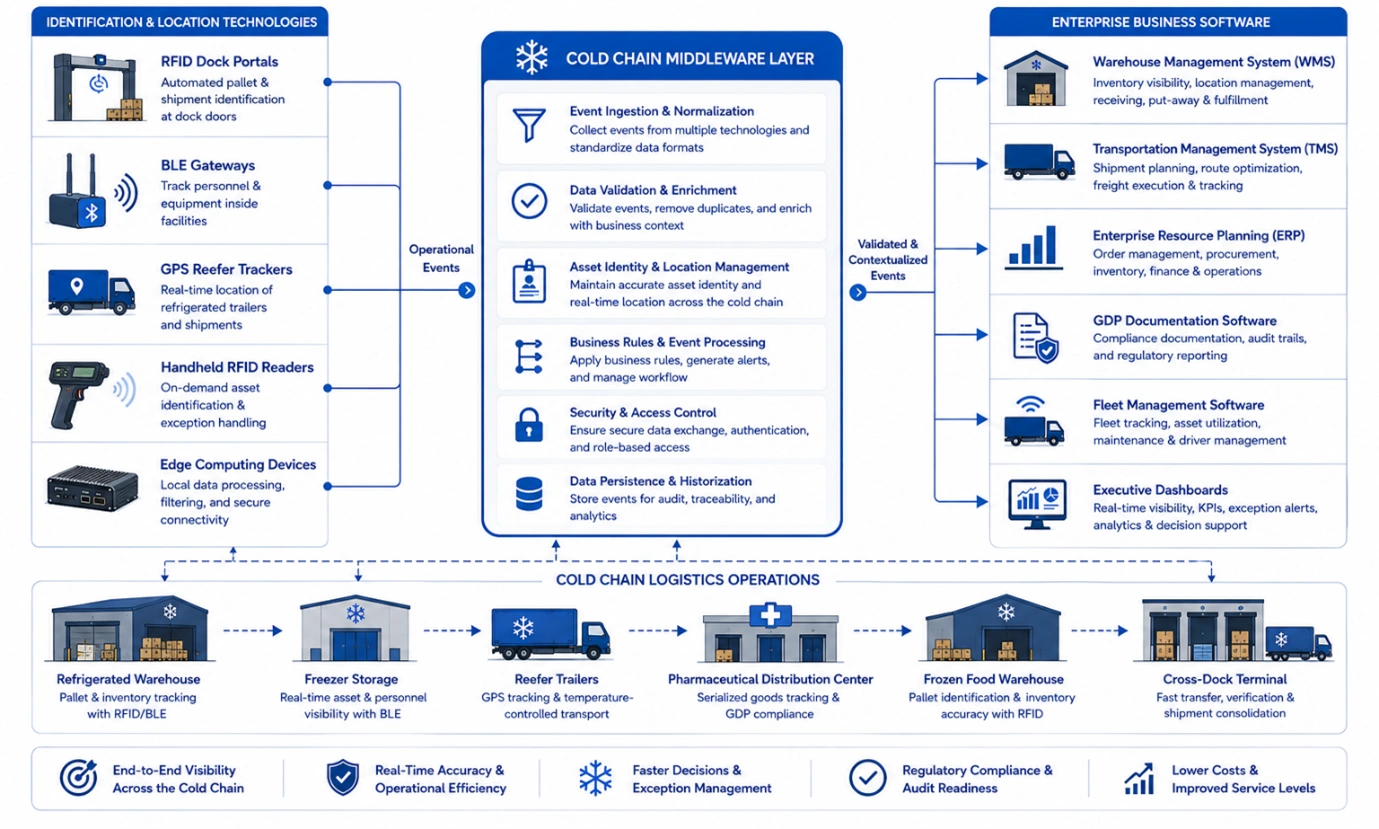
Middleware provides the communication layer responsible for coordinating information exchanged between RFID readers, BLE gateways, GPS tracking devices, edge computing equipment, warehouse software, transportation software, and enterprise applications.
Within refrigerated logistics, middleware performs considerably more than simple communication.
It standardizes operational events, validates transaction quality, manages secure communications, filters duplicate information, routes identification events, and prepares data for downstream business systems.
ColdChainLog AI develops middleware solutions specifically for refrigerated logistics where pallet identification, reefer tracking, warehouse movements, access authorization, custody transfers, and shipment verification require dependable synchronization.
Refrigerated transportation continuously generates operational events throughout shipment lifecycles.
Middleware receives information from numerous operational technologies before distributing validated events to authorized business software.
Typical synchronized operational events include:
Reefer trailer identification
Trailer arrival confirmation
Departure verification
Dock assignment
RFID pallet identification
Warehouse receiving confirmation
Shipping verification
Driver authorization
Asset utilization updates
Electronic custody transfers
Inventory movement confirmation
Fleet location updates
Rather than forwarding every event directly, middleware validates transaction quality, eliminates duplicate reads, verifies business rules, and distributes only meaningful operational information.
This significantly improves enterprise data quality while reducing unnecessary processing across multiple business systems.
Cold chain organizations rarely operate a single refrigerated warehouse.
Enterprise operations commonly include:
National pharmaceutical distribution networks
Regional freezer warehouses
Cross-dock terminals
Airport cold storage
Port refrigerated logistics
Grocery fulfillment centers
Third-party logistics facilities
Manufacturing distribution centers
Healthcare distribution hubs
Every facility often operates different workflows while still sharing centralized inventory visibility.
ColdChainLog AI middleware synchronizes these geographically distributed operations using standardized operational events that preserve consistent inventory records throughout the enterprise.
Authorized users obtain visibility into refrigerated inventory regardless of whether shipments reside inside warehouse storage, cross-docking operations, reefer trailers, staging lanes, or regional fulfillment facilities.
Different operational events require different destinations.
For example:
Warehouse receiving events update WMS software.
Shipment departures synchronize with TMS software.
Inventory adjustments update ERP records.
Custody transfers support GDP documentation.
Authorized access events update security software.
Trailer utilization updates fleet management applications.
Shipment completion notifies downstream logistics partners.
ColdChainLog AI routing software directs each validated event toward the appropriate destination without requiring duplicate manual entry.
Business rules determine which applications receive each operational transaction while maintaining security, traceability, and operational consistency across the enterprise.
Benefits of Middleware for Cold Chain Logistics
Properly designed middleware simplifies enterprise operations while improving information quality throughout refrigerated logistics.
Key operational advantages include:
Reduced manual data entry
Higher inventory accuracy
Faster shipment verification
Improved warehouse coordination
Better reefer fleet visibility
Simplified custody documentation
Reliable FEFO inventory synchronization
Consistent pallet identification
Improved access authorization management
Reduced duplicate transactions
Faster enterprise reporting
Better operational scalability
Organizations operating multiple refrigerated warehouses particularly benefit because middleware provides a consistent communication layer regardless of individual warehouse procedures.
AIoT-Enabled Cold Chain Middleware Integration for Refrigerated Logistics Operations
Shows how the Cold Chain Middleware Layer validates and routes identification events from RFID, BLE, GPS, handheld readers, and edge computing devices to enterprise business systems including WMS, TMS, ERP, GDP documentation, fleet management, and executive dashboards. The diagram highlights end-to-end connectivity across refrigerated warehouses, freezer storage, reefer transportation, pharmaceutical distribution, frozen food logistics, and cross-dock facilities while emphasizing identification, location visibility, and enterprise integration.
Cold Chain Edge Computing for Reefer Operations
Large refrigerated logistics networks generate continuous operational events from distribution centers, cross-dock facilities, reefer trailers, freezer warehouses, and pharmaceutical storage locations. Sending every identification event directly to centralized software can introduce unnecessary communication delays, especially when mobile assets travel through areas with intermittent connectivity.
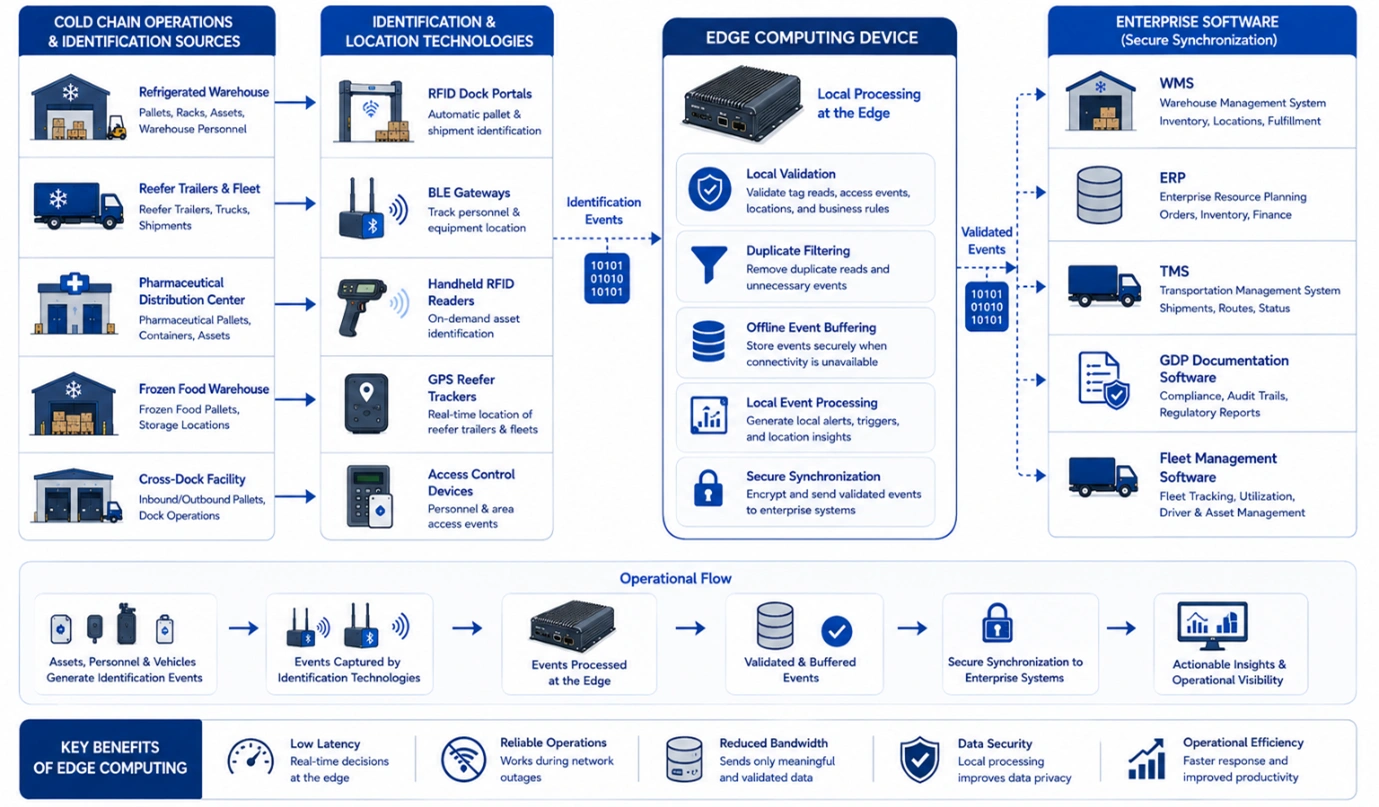
Edge computing addresses this challenge by processing operational events closer to the point where they are generated. Rather than forwarding every RFID read, BLE location update, GPS position, or access verification immediately, local edge devices validate, filter, prioritize, and securely synchronize relevant information with enterprise software.
ColdChainLog AI designs edge computing solutions for refrigerated logistics environments where reliable identification, asset visibility, and business continuity are essential during transportation and warehouse operations.
Reefer Edge Gateways
Reefer edge gateways act as local processing systems installed within refrigerated facilities or transportation assets. They aggregate information from RFID readers, BLE gateways, GPS tracking devices, access control equipment, and warehouse identification systems before securely forwarding validated events.
Typical responsibilities include:
Local RFID event processing
BLE location aggregation
Reefer trailer identification
Dock door transaction validation
Shipment verification
Access authorization processing
Local inventory synchronization
Secure enterprise communication
Processing information locally reduces unnecessary network traffic while improving responsiveness during receiving, shipping, and custody transfer operations.
Offline Event Buffering
Cold chain transportation frequently passes through regions where continuous network connectivity cannot be guaranteed. Mountain routes, rural highways, underground loading docks, port terminals, and cross-border logistics corridors may experience temporary communication interruptions.
Offline event buffering ensures operational continuity during these situations.
When communication becomes unavailable, edge computing systems securely store validated operational events until connectivity is restored.
Buffered information may include:
RFID pallet identification
Trailer arrivals
Trailer departures
Access authorization events
Custody transfers
Warehouse receiving confirmations
Shipment dispatch records
Driver authentication
Fleet location history
Once communication resumes, events are synchronized automatically in chronological order, maintaining complete operational traceability without requiring manual reconciliation.
Real-Time Operational Synchronization
Modern cold chain logistics depends upon rapid information sharing across warehouses, transportation operations, and enterprise business systems.
Edge computing supports near real-time synchronization by validating transactions locally before forwarding approved records to authorized software.
Examples include:
Immediate shipment confirmation after dock loading
Automatic warehouse inventory updates
Fleet movement synchronization
Distribution center receiving notifications
Cross-dock transfer confirmation
Electronic custody recording
Authorized personnel verification
Distribution scheduling updates
Local validation also improves enterprise data quality because duplicate reads and incomplete transactions are filtered before synchronization.
Cold Chain Deployment Models
Every refrigerated logistics organization operates under different operational, regulatory, cybersecurity, and business requirements. Some organizations prioritize centralized cloud accessibility, while others require local server deployment because of regulatory, security, or operational policies.
ColdChainLog AI supports multiple deployment models to accommodate these differing operational environments while maintaining consistent integration with warehouse, transportation, and enterprise business software.
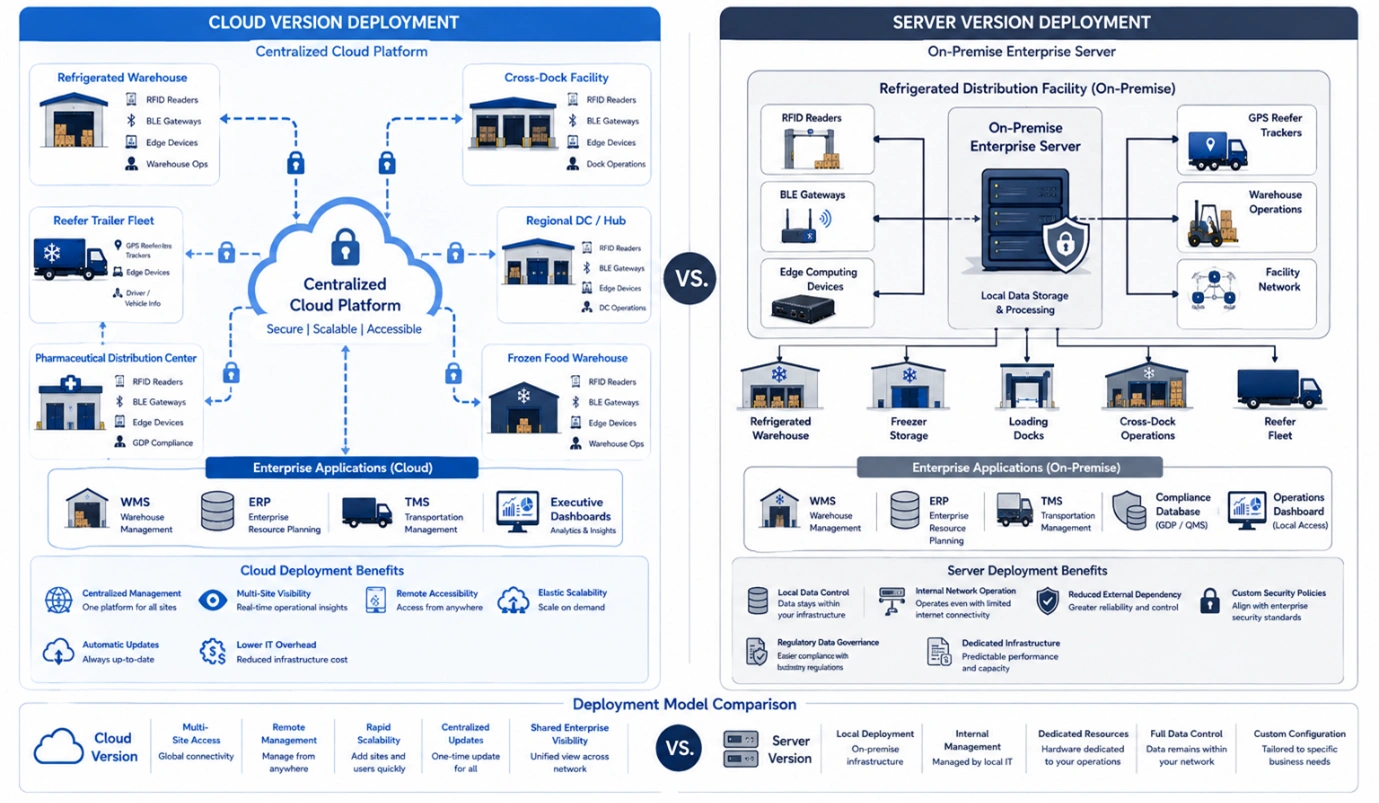
Cloud deployment centralizes operational information from geographically distributed refrigerated facilities into a unified software environment.
Organizations managing multiple warehouses, cross-dock terminals, reefer fleets, and regional distribution centers often benefit from centralized visibility.
Common advantages include:
Multi-site inventory visibility
Centralized fleet management
Enterprise reporting
Simplified software updates
Remote operational access
Scalable expansion
Cross-regional shipment visibility
Centralized administrative management
Cloud deployment is commonly selected by organizations operating nationwide refrigerated distribution networks requiring consistent access across multiple locations.
Certain cold chain operations maintain internal server infrastructure because of corporate cybersecurity requirements, regulatory obligations, customer policies, or operational preferences.
Server deployment provides local control over operational information while integrating with existing enterprise software.
Typical deployment environments include:
Pharmaceutical distribution centers
Government healthcare logistics
Military medical logistics
Highly regulated healthcare facilities
Research organizations
Private refrigerated warehouse networks
Benefits include:
Local information management
Corporate cybersecurity alignment
Controlled software administration
Internal operational governance
Customized integration workflows
Independent maintenance scheduling
Deployment decisions depend on multiple technical and operational factors rather than a single technology preference.
Organizations typically evaluate:
Number of refrigerated facilities
Geographic distribution
Fleet size
Internal IT resources
Cybersecurity policies
Regulatory compliance requirements
Existing enterprise software
Data governance policies
Business continuity objectives
Future operational expansion
ColdChainLog AI evaluates these factors during solution planning to recommend an appropriate deployment strategy without disrupting existing warehouse or transportation operations.
Both deployment models support AI and IoT identification and location workflows while allowing organizations to select the approach that best aligns with their operational requirements.
Benefits of Edge Computing and Flexible Deployment
Combining edge computing with an appropriate deployment model provides measurable operational improvements across refrigerated logistics.
Key benefits include:
Faster operational response
Reduced communication delays
Reliable synchronization during intermittent connectivity
Higher enterprise data quality
Improved inventory consistency
Better shipment traceability
Simplified multi-site management
Enhanced operational resilience
Lower manual reconciliation effort
Better scalability across growing logistics networks
These capabilities allow refrigerated logistics organizations to maintain accurate identification records, synchronized business software, and reliable operational visibility across warehouses, transportation assets, and distribution facilities.
Cloud vs. Server Deployment Models for AIoT-Enabled Cold Chain Logistics
Compares Cloud Version and Server Version deployment models for AIoT-enabled cold chain logistics. The diagram illustrates how refrigerated warehouses, reefer fleets, cross-dock facilities, and distribution centers connect through RFID, BLE, GPS, edge computing, and enterprise software, highlighting centralized accessibility with cloud deployment versus local data control and on-premise management with server deployment.
Edge Computing Workflow for AIoT-Enabled Cold Chain Logistics
Illustrates how identification and location events from RFID dock portals, BLE gateways, handheld RFID readers, GPS reefer trackers, and access control devices are processed by an edge computing device before being securely synchronized with WMS, ERP, TMS, GDP documentation, and fleet management software. The workflow demonstrates local validation, duplicate filtering, offline event buffering, and secure enterprise integration across refrigerated warehouses, reefer transportation, pharmaceutical distribution, frozen food logistics, and cross-dock facilities.
Cold Chain Enterprise Interoperability
Cold chain logistics relies on multiple enterprise software systems working together to maintain shipment visibility, inventory accuracy, regulatory documentation, and transportation coordination. Identification and location data generated through AI and IoT solutions delivers greater operational value when it is exchanged automatically with warehouse, transportation, and enterprise resource planning software instead of remaining isolated within individual applications.
ColdChainLog AI develops integration solutions that securely exchange validated operational events with enterprise software while preserving data consistency across refrigerated warehouses, cross-dock facilities, pharmaceutical distribution centers, frozen food logistics operations, and reefer transportation networks.
Rather than replacing existing business software, AIoT solutions complement current investments by supplying verified identification events, shipment status updates, personnel authorization records, and asset movement information that improve operational decision-making throughout refrigerated logistics operations.
Enterprise Resource Planning (ERP) software coordinates purchasing, inventory valuation, financial reporting, order fulfillment, production planning, and enterprise resource management. Accurate identification data improves ERP reliability by ensuring that inventory movements reflect actual warehouse and transportation activities.
ColdChainLog AI supports ERP integration for operational activities including:
Shipment receipt confirmation
Inventory transaction validation
Purchase order reconciliation
Batch and lot identification
FEFO inventory rotation
Warehouse transfer documentation
Customer order fulfillment
Product recall support
Automated synchronization reduces manual data entry while improving inventory accuracy throughout refrigerated distribution operations. ERP software receives validated identification records instead of raw device transactions, helping maintain consistent enterprise records and reducing duplicate inventory events.
Warehouse Management Systems (WMS) coordinate inventory locations, pallet movements, storage assignments, picking operations, replenishment, and outbound shipping throughout refrigerated distribution facilities.
AI and IoT identification technologies strengthen WMS performance by providing continuous visibility into inventory movements across receiving docks, cold rooms, blast freezers, staging lanes, and shipping areas.
Integrated workflows commonly include:
RFID pallet receiving
Automated storage confirmation
Put-away verification
Cold room location updates
FEFO inventory rotation
Frozen inventory replenishment
Picking validation
Shipment staging confirmation
Validated identification records improve warehouse accuracy while supporting rapid inventory reconciliation during high-volume refrigerated operations.
Transportation Management Systems (TMS) coordinate shipment scheduling, carrier operations, fleet utilization, route execution, and delivery documentation across refrigerated transportation networks.
AIoT identification data supports transportation software by automatically synchronizing shipment milestones throughout the transportation lifecycle.
Typical integration events include:
Trailer arrival confirmation
Trailer departure verification
Dock assignment updates
Electronic proof of loading
Custody transfer documentation
Route departure records
Delivery confirmation
Fleet utilization reporting
This synchronized workflow provides transportation managers with accurate shipment status while reducing administrative workload associated with manual reporting.
Enterprise interoperability extends beyond connecting individual software applications. Successful integration depends on secure, reliable information exchange using standardized communication methods that support long-term scalability.
ColdChainLog AI supports enterprise connectivity through technologies such as:
REST APIs
MQTT messaging
OPC UA where industrial operations require interoperability
Secure HTTPS communication
TLS-encrypted data exchange
Enterprise identity management
Event-based synchronization
Role-based access control
These integration methods enable refrigerated logistics organizations to exchange validated operational information while maintaining cybersecurity, regulatory compliance, and enterprise governance policies.
Why Integration Matters for Multi-Facility Cold Chain Networks
Organizations operating multiple refrigerated warehouses, pharmaceutical distribution centers, cross-dock terminals, and reefer transportation fleets require consistent operational visibility across geographically dispersed facilities.
Disconnected software environments often create duplicate records, delayed shipment updates, inconsistent inventory balances, and increased administrative effort. AI and IoT integration addresses these challenges by creating a synchronized operational workflow that connects identification events with enterprise business processes.
Integrated solutions provide measurable operational advantages across complex refrigerated logistics networks.
Key business outcomes include:
Consistent inventory records across multiple facilities
Faster shipment verification
Reduced manual reconciliation
Improved custody chain documentation
Better FEFO inventory execution
Faster recall readiness
More accurate transportation visibility
Improved warehouse utilization
Better fleet coordination
Enhanced regulatory documentation
Greater operational transparency
Simplified enterprise reporting
Organizations managing pharmaceutical products, frozen foods, temperature-sensitive healthcare supplies, biologics, fresh produce, dairy products, seafood, and other perishable goods benefit from synchronized information that follows shipments throughout receiving, storage, transportation, cross-docking, and final delivery.
AI and IoT supports these operations by combining AI with connected devices, identification technologies, industrial systems, and enterprise software. Depending on operational requirements, solutions may incorporate Industrial AI, Edge AI, machine learning, computer vision, and Physical AI to improve identification accuracy, automate business workflows, and strengthen decision support while keeping existing enterprise software at the center of day-to-day operations.
Applications Across Cold Chain Logistics
System integration supports a broad range of refrigerated logistics environments where reliable identification, traceability, and enterprise synchronization are operational priorities.
Typical applications include:
Pharmaceutical cold storage facilities
Vaccine distribution centers
Frozen food distribution warehouses
Fresh produce logistics hubs
Dairy distribution operations
Seafood cold storage terminals
Meat processing distribution centers
Grocery fulfillment facilities
Cross-dock refrigerated transfer centers
Third-party cold storage providers
Regional reefer transportation fleets
Last-mile refrigerated delivery operations
Each environment presents different operational requirements, but all benefit from accurate identification records, synchronized enterprise software, and secure information exchange between warehouse operations and transportation systems.
Connecting Cold Chain Operations Through Enterprise Integration
Reliable AI and IoT integration enables refrigerated logistics organizations to connect identification technologies with the enterprise software already responsible for managing inventory, transportation, regulatory documentation, and warehouse operations.
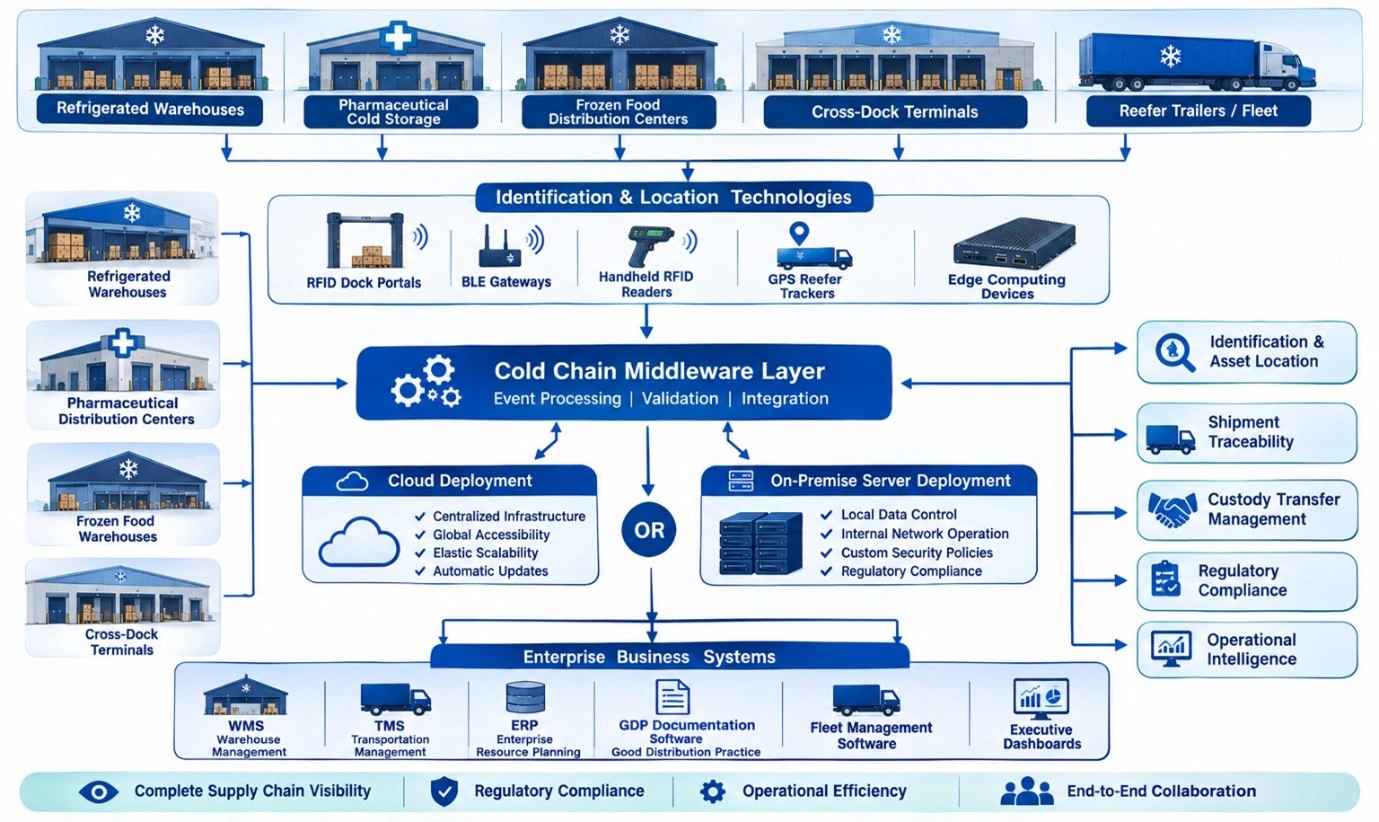
Rather than functioning as isolated technologies, RFID readers, BLE location systems, GPS tracking devices, edge computing solutions, and secure middleware work together to deliver validated operational information to ERP, WMS, TMS, and other authorized business applications.
ColdChainLog AI develops integration solutions that emphasize dependable interoperability, secure communication, flexible deployment, and operational continuity across refrigerated warehouses, pharmaceutical logistics facilities, frozen food distribution centers, and reefer transportation networks. By aligning identification workflows with enterprise software, organizations improve shipment visibility, inventory accuracy, regulatory compliance, and business resilience while supporting long-term operational growth.
Enterprise AIoT Integration for Cold Chain Logistics Across Warehouses, Transportation, and Business Systems
Illustrates how AIoT-enabled cold chain logistics connects refrigerated warehouses, pharmaceutical storage, frozen food distribution centers, cross-dock terminals, and reefer fleets through RFID, BLE, GPS, edge computing, and secure middleware. The diagram shows validated identification and traceability data flowing to WMS, ERP, TMS, GDP documentation, fleet management software, and executive dashboards using either cloud or on-premise deployment to support enterprise interoperability and regulatory compliance.
Why ColdChainLog AI
ColdChainLog AI was established within Aperture Venture Studio with support from GAO, drawing upon more than two decades of practical IoT experience across industrial logistics and supply chain operations. The company builds on knowledge gained through thousands of successful IoT deployments and customer engagements involving refrigerated warehouses, distribution centers, transportation operations, and temperature-controlled logistics environments.
Research and development activities are supported by rigorous quality assurance processes, experienced engineering teams, and remote as well as onsite technical support. Leadership includes Ph.D. professionals from leading universities, supported by strategic partners and subject matter experts with extensive experience in enterprise AI and IoT deployments.
Through experience derived from GAO, ColdChainLog AI has contributed to projects supporting Fortune 500 organizations, leading research institutions, universities, and government agencies throughout the United States and Canada. This experience enables the company to design practical identification and location solutions that integrate effectively with existing enterprise software while supporting operational reliability, cybersecurity objectives, and regulatory requirements.
Contact Us