
AI-Enabled Functions for Cold Chain Logistics Operations
Predictive Decision Support for Refrigerated Warehousing, Reefer
Transportation, and Perishable Supply Chains
AI and IoT Software Designed for Cold Chain Operations
Cold chain logistics requires more than maintaining refrigerated environments. Every shipment, pallet, reusable container, reefer trailer, loading dock, and warehouse location must be accurately identified and coordinated while maintaining product integrity throughout transportation and storage. Pharmaceutical products, vaccines, biologics, frozen foods, dairy products, fresh produce, seafood, and other temperature-sensitive goods move through multiple custody transfers where operational accuracy directly affects compliance, inventory quality, and customer service.
ColdChainLog AI delivers AI and IoT software developed specifically for refrigerated logistics operations. AIoT combines AI with connected industrial equipment, identification technologies, edge computing, and enterprise software. Depending on operational requirements, AI models may incorporate machine learning, computer vision, Industrial AI, Edge AI, and Physical AI to analyze operational events and support better decisions across warehouses, distribution centers, reefer fleets, and cross-dock facilities.
Unlike hardware-focused pages, this section concentrates on the software capabilities that transform operational data into recommendations, forecasts, alerts, and decision support. These functions help logistics teams identify operational risks, improve resource utilization, reduce manual intervention, and maintain compliance with food safety and pharmaceutical distribution requirements.
The software is organized into five operational capability groups reflecting common refrigerated logistics workflows:
Workforce safety
Facility access management
Reefer and pallet asset analytics
Perishable inventory optimization
Temperature excursion management
Each capability supports enterprise-scale cold chain operations while integrating with warehouse management systems, transportation management systems, enterprise resource planning software, and quality management applications.
AI and IoT Functions Supporting Refrigerated Logistics
Cold chain logistics differs from conventional warehousing because products continuously move through refrigerated rooms, freezer zones, blast chillers, loading docks, cross-dock terminals, reefer trailers, and delivery vehicles. Every transfer creates opportunities for shipment delays, loading errors, unauthorized access, misplaced pallets, inventory aging, and regulatory documentation gaps.
AI and IoT software continuously evaluates identification events, operational workflows, historical logistics data, and enterprise transactions to improve operational awareness. Rather than replacing warehouse personnel, dispatchers, supervisors, or logistics planners, the software provides actionable recommendations that support faster and more informed decisions.
Organizations commonly use these AI capabilities to improve:
Warehouse labor coordination
Cold room workforce accountability
Dock access authorization
Reefer trailer utilization
Pallet movement visibility
FEFO inventory execution
Batch traceability
HACCP documentation support
GDP compliance workflows
Cross-facility operational consistency
Because these capabilities are software driven, organizations can deploy them independently while integrating with existing RFID, BLE, GPS, LoRaWAN, warehouse software, transportation software, and enterprise business systems.
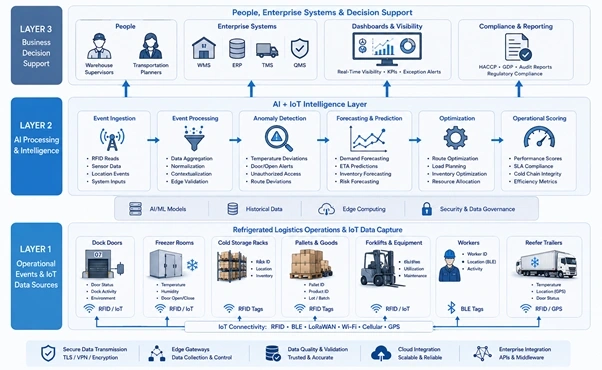
Layered AI and IoT Workflow for Refrigerated Logistics Operations
Illustrates how operational events from refrigerated warehouses, reefer trailers, forklifts, pallets, workers, and RFID identification points are processed by AI software before being delivered to warehouse supervisors, transportation planners, enterprise systems, dashboards, and compliance reporting. The layered workflow highlights how AI and IoT supports operational visibility, forecasting, optimization, and business decision-making across cold chain logistics.
Cold Chain Workforce Safety
Cold storage operations expose personnel to demanding working conditions that include freezing temperatures, confined refrigerated areas, high forklift traffic, loading docks, and continuous product movement. Maintaining workforce safety requires accurate personnel identification, location awareness, operational compliance, and rapid response to abnormal situations.
ColdChainLog AI uses operational events generated through identification technologies to help supervisors understand workforce movement across refrigerated facilities. Rather than depending entirely on manual observations, AI software evaluates movement patterns, access records, work schedules, and operational activities to identify situations that may require attention.
Accurate worker identification improves accountability throughout refrigerated warehouses and distribution facilities. Personnel entering freezer rooms, cold vaults, loading bays, or restricted operational zones can be automatically identified, allowing supervisors to maintain accurate workforce visibility.
Typical applications include:
Cold room worker accountability
Personnel location verification
Restricted freezer zone authorization
Shift activity analysis
Emergency personnel identification
Contractor access validation
Visitor movement documentation
Workforce utilization reporting
These capabilities support safer operations while reducing administrative effort associated with manual attendance tracking and incident investigations.
Warehouse personnel frequently operate forklifts, pallet handling equipment, and loading systems within confined refrigerated environments. AI software reviews operational records to help supervisors identify deviations from established procedures and support continuous operational improvement.
Examples include:
Forklift operator authorization verification
PPE compliance evaluation
Restricted work area enforcement
Shift transition analysis
Workforce allocation recommendations
Operational workload balancing
Historical operational records also support workforce planning by identifying recurring congestion, resource bottlenecks, and staffing trends across refrigerated facilities.
Organizations implementing AI-assisted workforce management commonly seek improvements in:
Worker accountability
Emergency response coordination
Operational compliance
Labor utilization
Shift planning
Workforce documentation
Safety reporting
Regulatory recordkeeping
The result is greater operational transparency while maintaining efficient warehouse activities throughout refrigerated logistics operations.
Cold Chain Dock and Facility Access
Loading docks, cold vaults, freezer rooms, blast chillers, and reefer staging areas represent critical operational control points throughout refrigerated logistics. Accurate access management protects product integrity, supports regulatory compliance, and reduces operational disruptions.
ColdChainLog AI evaluates identification events associated with employees, contractors, visitors, transportation personnel, and logistics partners to improve facility security while maintaining efficient material movement.
Secure Access Management
Rather than relying exclusively on manual credential verification, AI software evaluates access activity using historical operational behavior and predefined authorization policies.
Typical software functions support:
Dock door credential verification
Cold vault authorization
Blast chiller access control
Loading bay entry validation
Visitor authorization management
Contractor access documentation
Driver arrival verification
Temporary credential administration
Automated authorization helps reduce unauthorized entry while maintaining efficient logistics workflows.
Operational Event Analysis
Access events also provide valuable operational information beyond physical security. AI software analyzes movement history to identify operational trends that may affect warehouse productivity and shipment coordination.
Examples include:
Loading bay utilization analysis
Door activity patterns
Reefer staging efficiency
Vehicle arrival coordination
Cross-shift access reporting
Facility occupancy analysis
Congestion identification
Workflow optimization opportunities
Warehouse managers can use these insights to improve dock scheduling, labor allocation, and transportation coordination while reducing unnecessary delays.
Compliance and Audit Readiness
Food distribution facilities and pharmaceutical logistics providers frequently maintain detailed access records to support internal governance and regulatory obligations.
AI-assisted documentation helps organizations maintain:
Personnel access histories
Visitor records
Driver verification logs
Cold storage entry documentation
Restricted area activity reports
Operational audit records
These records simplify investigations, support compliance programs, and improve operational accountability without increasing manual administrative work.
Applications Across Cold Chain Logistics
The workforce safety and access management capabilities described above support a wide range of refrigerated logistics environments, including:
Pharmaceutical cold storage facilities
Vaccine distribution centers
Frozen food warehouses
Dairy distribution operations
Seafood processing logistics
Fresh produce cold storage
Grocery fulfillment centers
Refrigerated cross-dock terminals
Reefer fleet depots
Third-party cold storage providers
Although operational priorities vary across these environments, accurate personnel identification, secure access management, and operational visibility remain essential for maintaining efficient and compliant cold chain logistics.
Cold Chain Reefer and Pallet Asset Analytics
Refrigerated logistics depends on knowing the location, availability, and movement history of reefer trailers, pallets, reusable transport assets, roll cages, insulated containers, and warehouse handling equipment. Asset identification supports efficient freight movement while helping logistics teams reduce delays, improve equipment utilization, and maintain product traceability throughout refrigerated distribution.
ColdChainLog AI applies AI and IoT software to identification events collected from RFID, BLE, GPS, and enterprise operational systems. Rather than relying solely on manual inventory checks, logistics teams gain continuous visibility into asset movement across refrigerated warehouses, distribution centers, cross-dock terminals, and transportation networks.
Reefer trailers are valuable transportation assets that must be scheduled efficiently while maintaining delivery commitments and regulatory compliance. AI software evaluates operational history, trailer assignment records, yard movements, loading schedules, and transportation workflows to identify opportunities for improving fleet utilization.
Typical analytical capabilities include:
Reefer trailer utilization analysis
Trailer turnaround optimization
Yard allocation recommendations
Dock assignment optimization
Empty trailer identification
Trailer availability forecasting
Loading schedule coordination
Fleet utilization reporting
These insights help transportation planners reduce idle equipment, improve trailer availability, and support more efficient freight scheduling.
Pallets carrying pharmaceuticals, frozen foods, dairy products, fresh produce, and other temperature-sensitive goods move through receiving, storage, order fulfillment, staging, loading, transportation, and delivery. AI-assisted analysis improves visibility across every transfer point.
Common applications include:
Pallet movement history
Warehouse location verification
Staging area optimization
Shipment loading validation
Dock transfer analysis
Cross-dock routing recommendations
Returnable pallet tracking
Asset dwell time reporting
These capabilities reduce misplaced inventory while improving warehouse throughput and shipment accuracy.
Warehouse capacity directly affects inventory availability and operational efficiency. AI software analyzes pallet placement, storage density, movement frequency, and historical warehouse activity to support better space utilization.
Examples include:
Rack occupancy analysis
Storage location optimization
Fast-moving inventory positioning
Seasonal storage planning
Warehouse congestion analysis
Pick path optimization
Pallet accessibility evaluation
Capacity forecasting
Warehouse managers can use these recommendations to improve product accessibility while reducing unnecessary material handling.
Cold Chain Perishable Inventory Management
Managing perishable inventory requires balancing product availability with shelf-life limitations, customer demand, transportation schedules, and regulatory obligations. Inventory decisions must support food safety, pharmaceutical quality, and operational efficiency simultaneously.
ColdChainLog AI evaluates identification records, warehouse transactions, shipment history, production information, expiration dates, and enterprise inventory data to support inventory planning across refrigerated logistics operations.
FEFO Inventory Optimization
First Expired, First Out (FEFO) is a widely adopted inventory strategy within pharmaceutical distribution and food logistics. AI software evaluates expiration dates alongside warehouse movements to recommend inventory rotation priorities.
Capabilities include:
FEFO allocation recommendations
Expiration prioritization
Inventory aging analysis
Batch movement optimization
Shipment allocation support
Product availability forecasting
Rotation compliance reporting
Distribution planning assistance
These recommendations help reduce product expiration while supporting regulatory expectations.
Batch and Lot Traceability
Every movement of temperature-sensitive products contributes to a complete product history. AI software organizes identification records into searchable traceability documentation supporting recalls, investigations, and quality assurance activities.
Common capabilities include:
Batch identification
Lot history reconstruction
Custody transfer documentation
Shipment verification
Distribution path visualization
Recall preparation
Product genealogy
Audit documentation
Accurate traceability reduces investigation time while improving confidence in product movement records.
Inventory Forecasting
AI models evaluate historical inventory transactions together with operational patterns to assist planners with inventory decisions.
Typical analytical outputs include:
Stock replenishment recommendations
Inventory availability forecasts
Seasonal demand analysis
Distribution scheduling
Warehouse balancing
Product allocation planning
Receiving workload forecasts
Order fulfillment projections
Rather than replacing warehouse planning teams, these forecasts provide additional operational context for informed decision-making.
Cold Chain Temperature Excursion Management
Temperature excursions can affect product quality, regulatory compliance, and customer confidence. ColdChainLog AI evaluates operational records related to refrigerated handling activities together with environmental information supplied by connected equipment to help logistics teams identify events that require investigation.
The primary objective is not simply recording temperature values, but understanding how identified products, transportation assets, warehouse locations, and operational activities relate to temperature-related events.
AI software reviews operational history to identify relationships between handling activities and temperature excursions.
Typical analytical capabilities include:
Reefer setpoint deviation evaluation
Shipment exposure analysis
Cold room activity correlation
Loading duration assessment
Door opening impact analysis
Product handling sequence evaluation
Transportation delay assessment
Exception prioritization
These analyses provide logistics managers with contextual information that supports faster corrective action.
Food manufacturers, pharmaceutical distributors, and healthcare logistics providers operate under established quality programs such as HACCP and Good Distribution Practice (GDP). AI software assists compliance teams by organizing operational records into structured documentation.
Common capabilities include:
HACCP event scoring
GDP documentation support
Compliance reporting
Corrective action documentation
Operational trend analysis
Audit preparation
Exception management
Historical event retrieval
These capabilities simplify compliance activities while improving documentation quality.
Historical operational records provide opportunities for long-term improvement across refrigerated logistics.
Organizations frequently analyze:
Recurring warehouse bottlenecks
High-risk loading activities
Product handling trends
Transportation performance
Distribution consistency
Warehouse process efficiency
Seasonal operational patterns
Facility performance comparisons
These insights help logistics teams improve procedures while supporting continuous operational excellence.
Applications Across Cold Chain Logistics
The AI functions described on this page support organizations operating throughout refrigerated supply chains where product identification, location awareness, inventory control, and regulatory compliance are critical.
Representative applications include:
Pharmaceutical distribution centers managing vaccines, biologics, blood products, and specialty medicines.
Frozen food distribution facilities coordinating pallet movements and FEFO inventory rotation.
Grocery cold warehouses supplying regional retail distribution networks.
Dairy processing logistics requiring accurate batch traceability.
Seafood distribution centers managing rapid inventory turnover.
Fresh produce logistics supporting seasonal demand fluctuations.
Refrigerated transportation providers coordinating reefer trailer operations.
Cross-dock transfer hubs reducing shipment handling delays.
Third-party logistics providers managing customer inventory across shared refrigerated facilities.
Each deployment can be tailored to existing operational workflows while integrating with warehouse management systems, transportation management systems, enterprise resource planning software, and quality management applications.
How AI Models Are Developed for Cold Chain Logistics
ColdChainLog AI applies AI and IoT to refrigerated logistics by combining AI with connected industrial equipment, identification technologies, enterprise software, and edge computing. Depending on operational requirements, the solution may incorporate Industrial AI, Edge AI, machine learning, computer vision, and, where appropriate, Physical AI to support operational decision-making.
Rather than relying on isolated events, AI models evaluate relationships between identification records, logistics workflows, historical operating conditions, enterprise transactions, and operational policies. This approach enables software to recognize patterns, identify exceptions, estimate future operational conditions, and recommend actions that improve warehouse efficiency and transportation coordination.
The software focuses on operational events such as:
RFID identification records
BLE location events
GPS transportation updates
Warehouse movement transactions
Dock activity records
Workforce authorization events
Inventory movement history
Shipment milestones
Enterprise business records
Compliance documentation
These data sources provide operational context that enables AI models to generate recommendations while maintaining traceability throughout refrigerated logistics operations.
Continuous Learning Through Operational History
Cold chain operations continuously generate new identification events across warehouses, cross-dock facilities, transportation fleets, and distribution centers. AI models use historical operational records to improve forecasting accuracy while adapting to changing logistics patterns.
Examples of historical analysis include:
Seasonal shipping demand
Warehouse throughput variations
Fleet utilization trends
Product rotation behavior
Loading activity patterns
Asset availability
Labor allocation history
Shipment dwell times
Historical learning allows organizations to make more informed operational decisions without disrupting existing business processes.
Human Oversight Remains Essential
AI recommendations are designed to support logistics professionals rather than replace operational expertise. Warehouse supervisors, transportation planners, quality managers, and compliance teams remain responsible for reviewing recommendations, validating exceptions, and approving operational actions.
Human expertise is particularly valuable when responding to:
Unexpected transportation disruptions
Regulatory investigations
Product recalls
Customer-specific logistics requirements
Emergency operational situations
Quality assurance reviews
This collaborative approach combines AI-driven analysis with experienced operational judgment.
Benefits for Refrigerated Logistics Organizations
Organizations implementing AI and IoT software for cold chain logistics commonly pursue measurable operational improvements across warehouse operations, transportation management, inventory control, and compliance.
Expected benefits include:
Improved pallet identification accuracy
Better reefer trailer utilization
Faster inventory reconciliation
Enhanced FEFO execution
Reduced manual data entry
Improved workforce accountability
More efficient dock operations
Stronger product traceability
Better shipment visibility
Simplified audit preparation
Improved regulatory documentation
More accurate operational forecasting
Better enterprise coordination
Increased warehouse productivity
Improved customer service
These benefits contribute to more efficient refrigerated logistics while supporting pharmaceutical, healthcare, and food safety requirements.
Experience Supporting Industrial Logistics Operations
ColdChainLog AI was developed within Aperture Venture Studio with support from GAO. The broader organization draws upon more than two decades of industrial IoT experience gained through thousands of customer engagements and successful deployments across industrial logistics and supply chain operations.
This experience contributes to practical software design, enterprise integration expertise, and implementation methodologies suitable for refrigerated warehouses, pharmaceutical distribution facilities, grocery logistics networks, and refrigerated transportation providers.
Ongoing investment in research and development, rigorous quality assurance processes, and remote as well as onsite technical support helps organizations deploy dependable AI and IoT solutions that align with operational objectives.
The technical organization includes Ph.D. professionals, experienced engineers, and industry specialists working alongside strategic partners to address complex industrial logistics challenges. Throughout the years, the broader team has supported Fortune 500 companies, leading research institutions, universities, and government organizations across the United States and Canada.
Why Choose ColdChainLog AI
ColdChainLog AI focuses specifically on refrigerated logistics rather than providing generic AI software. Every capability is designed around the operational workflows commonly found within pharmaceutical distribution, frozen food logistics, grocery cold storage, refrigerated transportation, and cross-dock operations.
Key differentiators include:
Focus on identification and location solutions rather than generic monitoring
Support for RFID, BLE, LoRaWAN, GPS, and cellular communications
Integration with WMS, ERP, TMS, MES, and quality management software
Flexible cloud, private server, and hybrid deployment options
AI-assisted warehouse and transportation decision support
Enterprise-scale traceability and compliance documentation
Modular implementation aligned with existing logistics workflows
Strong industrial IoT experience supporting long-term operational reliability
Applications Across Cold Chain Logistics
The AI functions described throughout this page support a broad range of refrigerated logistics operations where identification, traceability, and operational visibility are essential.
Common implementation environments include:
Pharmaceutical cold storage facilities
Vaccine and biologics distribution centers
Frozen food distribution warehouses
Dairy product logistics operations
Fresh produce cold storage
Seafood distribution facilities
Grocery fulfillment centers
Refrigerated transportation fleets
Cross-dock cold transfer hubs
Third-party cold storage providers
Healthcare logistics organizations
Regional refrigerated distribution networks
Each implementation can be adapted to facility size, operational complexity, compliance requirements, and enterprise software environments while maintaining a consistent approach to identification, asset visibility, and operational coordination.
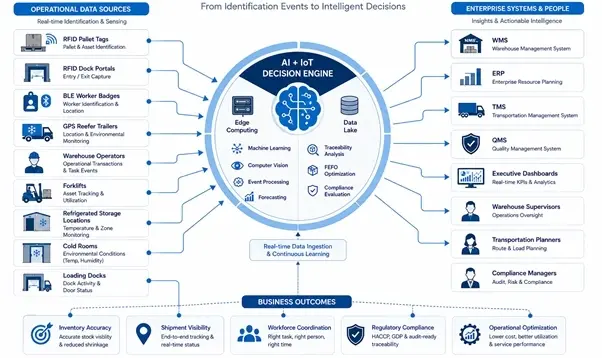
AI and IoT Hub-and-Spoke Solution for Cold Chain Logistics Enterprise Operations
This hub-and-spoke solution diagram illustrates how identification and location data from RFID pallet tags, BLE worker badges, GPS-enabled reefer trailers, and refrigerated warehouse operations is processed by AI and IoT software to support enterprise decision-making. The visualization highlights data flow to WMS, ERP, TMS, quality management systems, dashboards, and business outcomes including inventory accuracy, shipment visibility, regulatory compliance, workforce coordination, and operational optimization.
Traditional vs ColdChainLog AI-Enabled Cold Chain Logistics
Pallets are identified one at a time using handheld barcode scanners or paper shipment lists, increasing loading time and the risk of shipping errors.
RFID portal reads automatically identify every pallet entering or leaving cold storage, loading docks, and reefer trailers without interrupting material flow.
Chain of custody is recorded manually through printed delivery documents and handwritten signatures, making audits slower and more labor intensive.
Digital custody records are captured automatically as products move between warehouses, transportation providers, cross-docks, hospitals, retailers, and distribution centers.
Dock personnel visually verify trailers and shipments before loading or unloading refrigerated cargo.
RFID credentials and AI-assisted dock verification validate trailers, drivers, pallets, and loading events before product transfer begins.
Inventory visibility depends on scheduled cycle counts, often leaving warehouse managers unaware of pallet locations between audits.
RFID-based location awareness continuously updates inventory across freezer rooms, cold storage racks, staging lanes, and outbound shipping areas through WMS integration.
Reefer trailer utilization is managed reactively, responding only after trailers become unavailable or delivery schedules change.
AI analyzes trailer utilization patterns to improve reefer allocation, reduce idle equipment, and support transportation planning through TMS integration.
HACCP and GDP documentation requires manual data collection from multiple business systems before inspections or customer audits.
Compliance documentation is generated automatically from validated identification events, supporting HACCP, GDP, and internal quality reporting with consistent business records.
Warehouse, transportation, and business systems operate independently, requiring manual reconciliation of shipment information.
ColdChainLog AI connects RFID, BLE, GPS, edge computing, WMS, ERP, TMS, and quality systems, creating a synchronized operational view across refrigerated warehouses and transportation networks.
Workers locate pallets by searching warehouse aisles, increasing travel time and delaying order fulfillment.
AI-assisted pallet location and warehouse mapping guide operators directly to the correct storage location, improving FEFO execution and warehouse productivity.
Access to freezer rooms and restricted cold vaults is verified manually, making access audits difficult.
Digital access control records every authorized entry to refrigerated zones, supporting workforce safety, security, and regulatory compliance.
Management decisions rely on historical reports generated after operational issues have already occurred.
Operational dashboards present real-time warehouse and transportation status, helping supervisors make faster decisions based on current identification events and enterprise data.
Supporting the Next Generation of Cold Chain Logistics
Cold chain logistics continues to evolve as product volumes increase, regulatory expectations become more demanding, and customers require greater shipment visibility. AI and IoT enables organizations to improve operational awareness through connected identification technologies, intelligent software, enterprise integration, and data-driven decision support.
ColdChainLog AI helps refrigerated logistics organizations strengthen workforce accountability, improve asset utilization, optimize inventory rotation, support traceability, and simplify compliance activities without disrupting established warehouse and transportation workflows.
By combining AI with RFID, BLE, GPS, LoRaWAN, edge computing, and enterprise software integration, organizations can build scalable refrigerated logistics operations that improve efficiency, reduce operational risk, and support long-term supply chain resilience.
Contact Us