
About ColdChainLog AI
Purpose-Built AI and IoT Technology for the
Realities of Refrigerated Freight
Cold chain logistics operates under conditions that leave little room for operational error. Refrigerated warehouses, pharmaceutical distribution centers, frozen food facilities, reefer trailers, cross-dock terminals, and last mile delivery fleets all depend on accurate product identification, reliable asset visibility, controlled facility access, and synchronized business records. ColdChainLog AI develops AI and IoT solutions specifically for these operational environments, helping organizations maintain reliable movement of temperature-sensitive products while improving operational visibility across distributed logistics networks.
Unlike general industrial software designed for broad manufacturing applications, ColdChainLog AI focuses on the workflows unique to refrigerated logistics. Product movement frequently spans multiple facilities, transportation providers, custody transfers, and regulatory checkpoints. Every pallet, refrigerated trailer, shipping container, warehouse location, and authorized worker contributes information that must remain accurate throughout receiving, storage, transportation, cross-docking, and final delivery.
AIoT combines AI with connected IoT equipment, industrial communication technologies, and enterprise software to improve operational decision making. Depending on the application, ColdChainLog AI incorporates Industrial AI, Edge AI, machine learning, computer vision, and secure identification technologies to support refrigerated logistics operations. Rather than concentrating primarily on environmental measurement, our solutions emphasize identification, location verification, asset movement, workforce visibility, inventory accuracy, and enterprise synchronization across cold chain facilities.
Organizations responsible for pharmaceutical products, frozen foods, biologics, vaccines, dairy products, fresh produce, seafood, meat processing, and grocery distribution face increasing operational complexity as distribution networks expand. ColdChainLog AI supports these organizations by helping connect warehouse operations, reefer transportation, inventory management, and enterprise software into coordinated business processes while preserving operational continuity across multiple facilities.
Brief Description of ApplicationsColdChainLog AI supports a broad range of refrigerated logistics operations, including pharmaceutical cold storage facilities, frozen food distribution centers, grocery cold warehouses, reefer transportation fleets, cross-dock transfer hubs, and last mile cold delivery services. AI and IoT solutions improve workforce visibility, access verification, pallet identification, trailer tracking, inventory management, shipment traceability, and enterprise software synchronization while supporting HACCP, GDP, and internal operational requirements.
Domain Focus and Technical Approach
Cold chain logistics presents operational requirements that differ significantly from other industrial environments. Products remain in motion across refrigerated warehouses, freezer rooms, blast chillers, loading docks, transportation corridors, distribution centers, retail fulfillment facilities, and healthcare supply chains. Every movement generates operational events that require accurate identification and timely synchronization with warehouse and transportation software.
ColdChainLog AI focuses on these operational workflows by combining AI and IoT technologies with enterprise identification and location solutions. Rather than treating refrigerated logistics as a variation of conventional warehousing, our engineering approach recognizes the unique operational demands associated with temperature-controlled inventory movement, regulated custody transfers, multi-site distribution, and refrigerated transportation.
Operational information is gathered from technologies such as RFID, Bluetooth Low Energy (BLE), GPS, cellular communication, LoRaWAN, handheld identification devices, fixed readers, and access management systems. These technologies work together to verify pallet movements, identify reefer trailers, authenticate personnel, record warehouse transactions, and synchronize logistics activities across enterprise software.
ColdChainLog AI solutions are designed to integrate naturally with existing warehouse management systems (WMS), transportation management systems (TMS), enterprise resource planning (ERP) software, fleet management applications, and regulatory documentation systems. This integration reduces duplicate data entry while improving the consistency of operational records throughout refrigerated logistics networks.
Identification and location verification remain central to this technical approach. Knowing which pallet entered a freezer, which authorized employee accessed a pharmaceutical vault, which reefer trailer arrived at a loading dock, or which shipment completed a custody transfer often provides greater operational value than collecting large volumes of raw environmental measurements without business context.
AI complements these operational records by identifying abnormal movement patterns, validating logistics transactions, improving inventory accuracy, forecasting operational bottlenecks, and assisting personnel responsible for managing large refrigerated distribution networks. Machine learning models continuously analyze historical logistics data to improve operational recommendations while maintaining compatibility with established warehouse procedures.
Because refrigerated logistics frequently involves geographically distributed facilities, ColdChainLog AI also supports cloud-based software deployments, server-based installations, and edge computing configurations. This flexibility enables organizations to select deployment models that align with operational requirements, cybersecurity policies, regulatory obligations, and long-term business strategies without disrupting existing workflows.
The technical approach emphasizes interoperability rather than replacement. Existing RFID systems, warehouse software, transportation applications, enterprise databases, and industrial communication networks continue to perform their intended roles while AI and IoT enhances operational visibility, decision support, and data quality throughout the refrigerated supply chain.
Why Cold Chain Logistics Requires Purpose-Built AI and IoT
Refrigerated logistics introduces operational challenges that generic industrial software cannot adequately address. Products often travel across multiple organizations before reaching their final destination, with every custody transfer requiring accurate identification, documented handling, and synchronized enterprise records.
Pharmaceutical products, biologics, vaccines, blood products, specialty chemicals, frozen foods, dairy products, fresh produce, and seafood each follow distinct handling procedures. Distribution centers must coordinate inbound receiving, freezer storage, order fulfillment, cross-docking, transportation scheduling, and outbound shipping while maintaining complete product traceability.
Facility operations frequently include:
Refrigerated distribution centers
Pharmaceutical cold rooms
Frozen food warehouses
Cross-dock logistics terminals
Blast chilling facilities
Reefer trailer yards
Grocery fulfillment centers
Medical storage facilities
Third-party logistics warehouses
Regional distribution hubs
Every operational environment introduces unique movement patterns that require accurate identification and reliable business synchronization. Warehouse operators must verify pallet arrivals, confirm storage locations, authorize worker access, coordinate forklift activities, record trailer departures, and maintain consistent inventory records across multiple enterprise systems.
ColdChainLog AI addresses these requirements by emphasizing operational workflows instead of isolated hardware deployments. AI and IoT technologies support the movement of products throughout refrigerated logistics by connecting identification events with warehouse software, transportation systems, compliance documentation, and operational analytics.
People tracking also plays a significant role within refrigerated facilities. Authorized personnel frequently move between freezer rooms, loading docks, pharmaceutical storage areas, staging zones, and restricted access locations. Accurate worker location information assists with operational coordination, workforce safety procedures, access authorization, and emergency response while supporting internal operational policies.
Access verification represents another important operational requirement. Cold storage vaults, controlled pharmaceutical inventory, quarantine areas, and secure distribution facilities require reliable authentication before personnel or contractors enter restricted areas. AI-assisted verification improves operational security while automatically recording authorized facility access within enterprise software.
Asset visibility extends beyond pallets alone. Reefer trailers, refrigerated containers, forklifts, roll cages, reusable transport equipment, warehouse vehicles, and mobile refrigeration assets all contribute to daily logistics operations. Maintaining consistent visibility of these assets reduces search time, improves utilization, and supports more efficient warehouse scheduling.
ColdChainLog AI was developed around these real operational workflows rather than adapting generic industrial solutions to refrigerated logistics. This domain-focused approach helps organizations improve visibility across facilities, transportation assets, inventory movements, and workforce operations while supporting reliable enterprise integration throughout the cold chain.
Engineering Philosophy Around HACCP and GDP Compliance
Food safety and pharmaceutical distribution depend on documented operational procedures that extend well beyond refrigeration equipment. Every product movement, custody transfer, warehouse transaction, and transportation milestone contributes to regulatory compliance and operational accountability. ColdChainLog AI develops AI and IoT solutions with these documentation requirements in mind, helping organizations maintain reliable identification records that support established compliance processes rather than replacing them.
HACCP and Good Distribution Practice (GDP) frameworks require organizations to demonstrate that products have been handled according to documented procedures throughout storage and transportation. Accurate identification of pallets, cartons, reefer trailers, warehouse locations, and authorized personnel helps establish a consistent chain of operational records that can be reviewed during internal audits, customer assessments, or regulatory inspections.
Rather than generating isolated equipment data, ColdChainLog AI emphasizes operational events that have direct business value. Receiving confirmations, shipment dispatches, custody handoffs, trailer arrivals, dock assignments, warehouse transfers, and personnel access records are validated before being synchronized with enterprise software. This approach improves the quality and consistency of business records while reducing duplicate transactions and unnecessary manual reconciliation.
Compliance-oriented workflows commonly include:
Receiving verification for inbound refrigerated shipments
Warehouse location confirmation for stored inventory
Electronic custody transfer documentation
Authorized access verification for restricted storage areas
FEFO inventory movement records
Shipment dispatch confirmation
Trailer loading and unloading validation
Distribution center receiving acknowledgments
Audit-ready operational history
AI and IoT also supports continuous improvement by identifying recurring operational patterns that may affect workflow efficiency or documentation quality. Repeated loading delays, frequent pallet location changes, unauthorized access attempts, or inconsistent custody records can be highlighted for operational review without disrupting existing warehouse procedures.
ColdChainLog AI is designed to complement quality management practices by providing accurate identification and location information that strengthens documentation throughout refrigerated logistics operations. Organizations remain responsible for their own regulatory obligations, while the supporting technology helps improve the accuracy, availability, and consistency of operational records used during compliance activities.
Commitment to Connectivity Technologies Matched to Cold Chain Environments
Reliable communication is fundamental to refrigerated logistics because products frequently move across warehouses, transportation fleets, cross-dock facilities, and regional distribution centers. ColdChainLog AI selects communication technologies according to operational requirements rather than relying on a single wireless standard for every deployment.
Each logistics environment presents different coverage, mobility, and infrastructure challenges. Fixed warehouse facilities often benefit from RFID dock portals and BLE location systems that support high-volume pallet movements and personnel identification. Large refrigerated campuses may require LoRaWAN connectivity to provide broad communication coverage across yard operations and outdoor storage areas. Reefer fleets traveling over long distances commonly depend on GPS and cellular communication for vehicle identification, fleet coordination, and shipment visibility.
Communication technologies supported within ColdChainLog AI solutions include:
RFID for pallet, carton, and shipment identification
BLE for personnel and asset location verification
GPS for fleet and trailer positioning
Cellular communication for mobile transportation assets
LoRaWAN for distributed logistics facilities
Wi-Fi for warehouse software connectivity
Industrial Ethernet for fixed operational equipment
Secure VPN and encrypted communication for enterprise connectivity
Multiple technologies often operate together within the same logistics network. A pharmaceutical distribution center, for example, may use RFID for pallet verification, BLE for workforce location, GPS for inbound trailer visibility, and cellular communication for long-haul transportation. ColdChainLog AI coordinates these technologies so that operational events are validated before reaching warehouse, transportation, or enterprise software.
Connectivity planning also considers practical operating conditions. Distribution centers experience continuous vehicle movement, warehouse traffic, dock congestion, and varying communication conditions. Mobile reefer trailers may temporarily lose connectivity during transportation before reconnecting at logistics hubs or customer locations. ColdChainLog AI incorporates edge computing and secure synchronization processes that maintain operational continuity even when communication conditions change.
Technology selection is therefore driven by business objectives, facility layout, fleet operations, security requirements, and integration needs rather than by preference for any individual wireless protocol. This flexible approach enables organizations to expand their AI and IoT capabilities while preserving compatibility with existing infrastructure and future operational growth.
Experience Supporting Complex Cold Chain Operations
Cold chain logistics rarely operates within a single warehouse or transportation route. Modern distribution networks often include multiple refrigerated facilities, regional fulfillment centers, third-party logistics providers, contract carriers, pharmaceutical storage locations, and retail distribution hubs. Coordinating identification, inventory, transportation, and enterprise software across these environments requires both technical expertise and operational understanding.
ColdChainLog AI draws upon extensive experience gained through large-scale IoT deployments supporting industrial logistics and supply chain operations. Created within Aperture Venture Studio with support from GAO, the company benefits from more than two decades of practical IoT experience across thousands of customer deployments. This experience has helped shape AI and IoT solutions that address real operational challenges encountered in refrigerated freight, warehouse logistics, and enterprise integration.
Engineering teams understand that successful projects depend on more than hardware installation. Every implementation begins with an assessment of warehouse workflows, transportation processes, identification requirements, communication infrastructure, cybersecurity considerations, and integration objectives. Solutions are then adapted to fit existing operational procedures rather than requiring organizations to redesign their logistics operations around new technology.
Support extends across a variety of refrigerated logistics environments, including:
Pharmaceutical distribution and healthcare logistics
Frozen food manufacturing and warehousing
Grocery distribution networks
Third-party logistics providers
Regional cold storage facilities
Reefer transportation fleets
Cross-dock transfer operations
Multi-site warehouse organizations
ColdChainLog AI also emphasizes long-term operational support. Remote technical assistance, onsite services when required, quality assurance procedures, and continuous software improvement help organizations maintain dependable AI and IoT solutions as logistics networks evolve. Research and development efforts remain focused on practical business requirements, ensuring that new capabilities align with changing operational, regulatory, and enterprise integration needs.
Unified AI and IoT Solution for Enterprise Cold Chain Logistics Operations
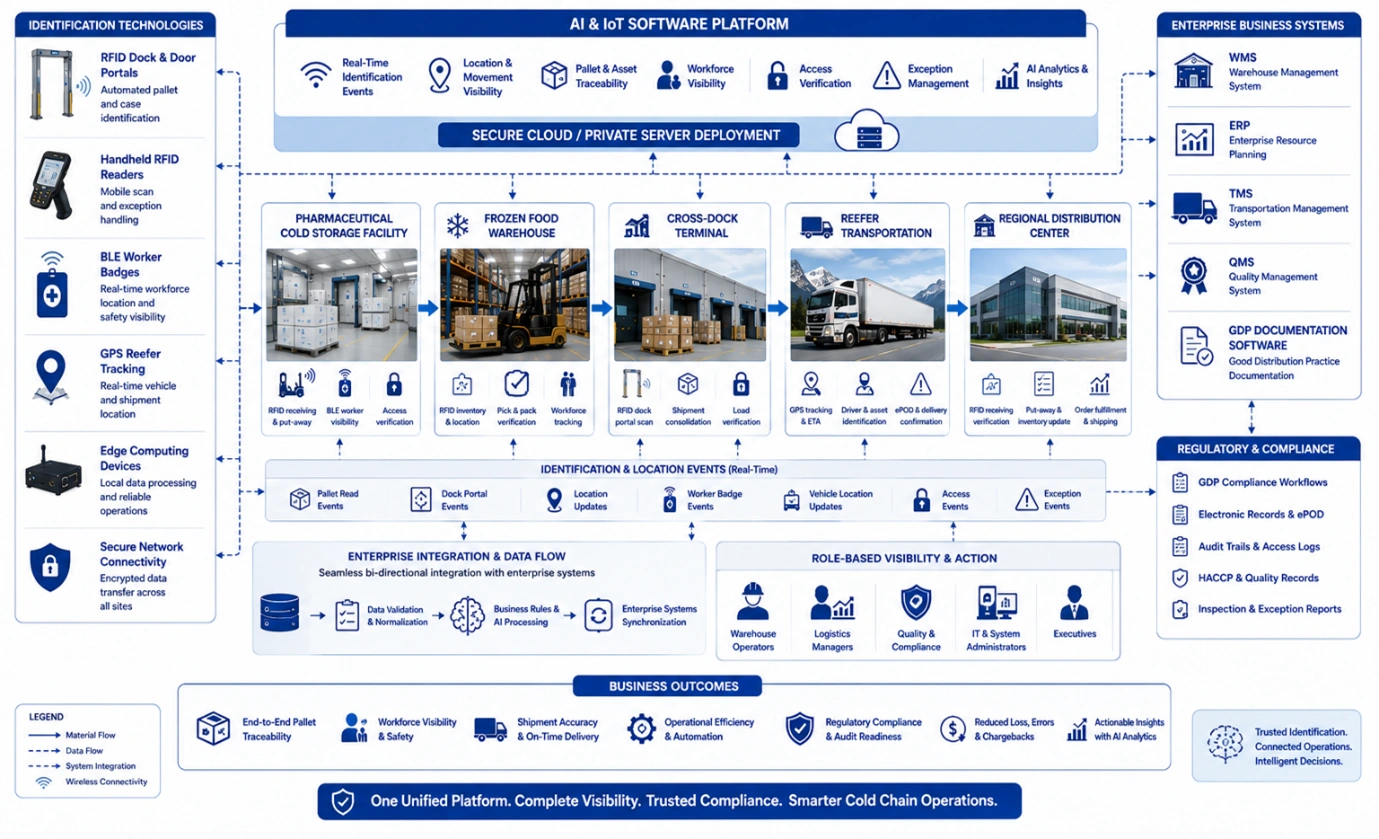
This enterprise illustration demonstrates how ColdChainLog AI unifies identification technologies, enterprise software, and refrigerated logistics operations into a coordinated AI and IoT solution. It highlights RFID, BLE, GPS, edge computing, and secure deployment working together with WMS, ERP, TMS, and compliance systems to improve pallet traceability, workforce visibility, shipment verification, and end-to-end operational coordination across pharmaceutical, frozen food, and refrigerated distribution networks.
Research, Engineering, and Customer Support
Developing dependable AI and IoT solutions for refrigerated logistics requires continuous investment in research, software engineering, quality assurance, and customer support. ColdChainLog AI combines these disciplines to help organizations deploy identification and location solutions that remain reliable as warehouse operations, transportation networks, and enterprise systems evolve.
Research activities focus on improving operational efficiency across cold storage facilities, reefer transportation, and multi-site distribution networks. Engineering teams evaluate emerging technologies such as Edge AI, machine learning, computer vision, RFID, BLE, LoRaWAN, GPS, and secure enterprise communications to determine where they provide measurable value within refrigerated logistics workflows. Every technology is assessed according to operational practicality, integration requirements, scalability, and long-term maintainability.
Software development follows structured quality assurance processes to help ensure stable performance in demanding logistics environments. Updates are designed to maintain compatibility with warehouse management systems, transportation management systems, enterprise resource planning software, and existing identification infrastructure.
This approach helps organizations expand their AI and IoT capabilities without unnecessary disruption to daily operations.
Customer support extends beyond deployment. Technical specialists provide assistance during planning, implementation, integration, testing, and operational optimization. Support may be delivered remotely or onsite depending on project requirements, helping logistics organizations maintain consistent operations throughout the lifecycle of their AI and IoT solution.
Continuous collaboration with customers also contributes to future product development. Operational feedback from refrigerated warehouses, pharmaceutical distributors, frozen food logistics providers, grocery fulfillment centers, and transportation organizations helps guide research priorities so that future enhancements address practical industry needs rather than theoretical capabilities.
Working with Enterprise Cold Chain Organizations
Large cold chain organizations often operate across multiple regions, distribution centers, transportation providers, and warehouse facilities while serving highly regulated industries such as pharmaceuticals, healthcare, food manufacturing, grocery distribution, and biotechnology. These environments require technology that integrates with existing business processes instead of introducing unnecessary operational complexity.
ColdChainLog AI supports organizations throughout every stage of AI and IoT adoption, from initial operational assessment through enterprise integration and long-term expansion. Projects typically begin with an evaluation of logistics workflows, facility layouts, communication infrastructure, asset identification methods, and software integration requirements. This assessment helps define an implementation strategy aligned with operational goals and existing IT investments.
Enterprise organizations benefit from solutions that can scale across geographically distributed facilities while maintaining consistent operational visibility. Common implementation objectives include:
Improving pallet and shipment traceability across multiple warehouses
Enhancing workforce visibility within refrigerated facilities
Strengthening access verification for controlled storage areas
Increasing inventory accuracy across distribution centers
Supporting fleet visibility for reefer transportation
Reducing manual reconciliation between warehouse and transportation records
Improving interoperability with ERP, WMS, and TMS software
Maintaining reliable business continuity during network interruptions
ColdChainLog AI also recognizes that every organization has unique cybersecurity, regulatory, and operational requirements. Cloud-based software, server-based deployments, and edge computing configurations are selected according to customer objectives, enabling organizations to preserve existing governance policies while expanding AI and IoT capabilities.
Over the years, the expertise supporting ColdChainLog AI has contributed to projects serving Fortune 500 companies, leading research organizations, prestigious universities, and government agencies throughout the United States and Canada. This broad experience strengthens the company's ability to support complex refrigerated logistics operations while maintaining a practical, engineering-focused approach.
Advancing Reliable AIoT-Enabled Cold Chain Operations
Cold chain logistics depends on more than refrigeration equipment. Every pallet movement, warehouse transaction, access event, custody transfer, and transportation milestone contributes to the reliable movement of temperature-sensitive products across complex distribution networks.
ColdChainLog AI develops AI and IoT solutions that emphasize accurate identification, location visibility, enterprise integration, and operational continuity throughout refrigerated logistics. By combining RFID, BLE, GPS, LoRaWAN, edge computing, and secure enterprise software integration, organizations can improve traceability, workforce coordination, inventory accuracy, and business synchronization across warehouses, reefer fleets, cross-dock facilities, and regional distribution centers.
Rather than replacing established operational processes, ColdChainLog AI complements existing warehouse, transportation, and enterprise systems with technologies designed specifically for refrigerated logistics. This domain-focused approach helps organizations strengthen operational visibility while supporting HACCP, GDP, and internal governance requirements across evolving cold chain networks.
Complete ColdChainLog AI Enterprise Solution for AIoT-Enabled Refrigerated Logistics
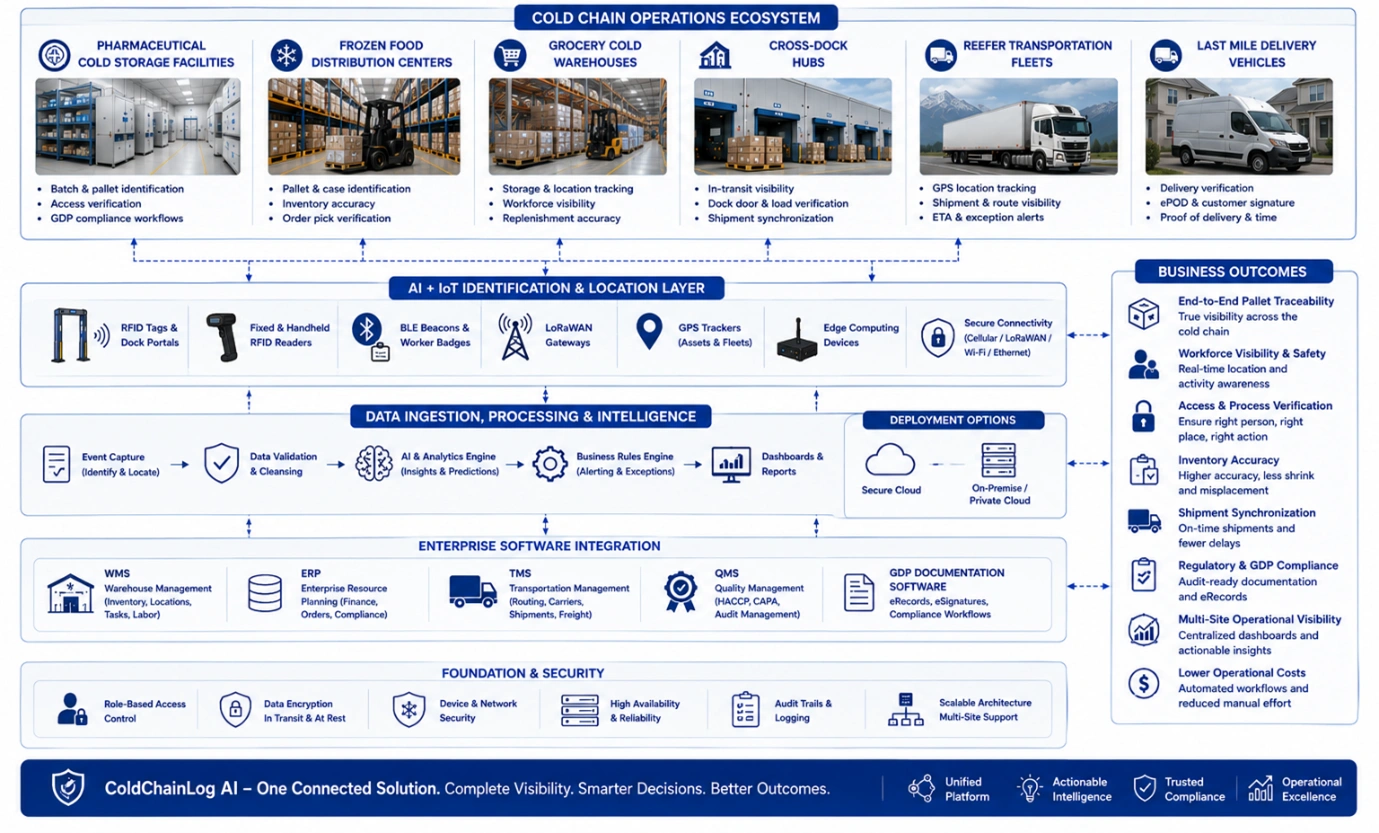
This enterprise solution diagram summarizes the complete ColdChainLog AI solution for refrigerated logistics by connecting cold storage facilities, transportation assets, identification technologies, enterprise software, and business outcomes. It illustrates how RFID, BLE, GPS, LoRaWAN, edge computing, and secure cloud or on-premise deployments support pallet traceability, workforce visibility, inventory accuracy, shipment synchronization, regulatory documentation, and enterprise-wide operational visibility across the cold chain.
Why Organizations Choose ColdChainLog AI
Organizations evaluating AI and IoT solutions for refrigerated logistics often require more than individual hardware components or standalone software applications. They seek technology partners with experience in enterprise integration, industrial communications, and operational workflows specific to temperature-controlled distribution.
ColdChainLog AI combines practical cold chain expertise with extensive IoT experience developed through years of industrial deployments. The company was created within Aperture Venture Studio with support from GAO, building upon more than two decades of IoT experience serving thousands of customers and delivering thousands of successful projects. Significant investment in research and development, rigorous quality assurance practices, and technical support delivered by highly experienced engineering teams contribute to dependable solutions for refrigerated logistics.
Engineering leadership includes Ph.D. professionals from leading universities, supported by strategic partners and industry specialists. This combination of technical expertise and real-world implementation experience enables ColdChainLog AI to support organizations ranging from regional refrigerated warehouses to multinational pharmaceutical distributors, food manufacturers, healthcare providers, and complex logistics enterprises.
Contact Us