
IoT Hardware Technologies for Cold Chain Logistics Facilities
Connectivity Designed for Refrigerated Warehouses, Reefer Fleets, and
Temperature-Controlled Distribution
IoT Hardware Built for the Demands of Cold Chain Logistics
Cold chain logistics environments place unique demands on connected hardware. Refrigerated warehouses, freezer rooms, blast chillers, cross-dock terminals, pharmaceutical storage areas, and refrigerated transportation fleets expose equipment to low temperatures, moisture, condensation, vibration, and continuous operational movement. Hardware selected for these environments must deliver dependable communication while maintaining consistent identification and location capabilities under demanding operating conditions.
ColdChainLog AI supports IoT hardware technologies specifically suited to refrigerated logistics. Rather than relying on a single wireless technology, the solution combines RFID, Bluetooth Low Energy (BLE), LoRaWAN, GPS, cellular communications, industrial gateways, and rugged field devices to provide reliable connectivity throughout warehouse and transportation operations.
AIoT combines AI with IoT devices, connected industrial equipment, and enterprise software. Depending on operational requirements, AI and IoT solutions may incorporate Industrial AI, Edge AI, machine learning, computer vision, and Physical AI. This page focuses on the physical hardware layer that captures operational events and enables communication with software systems rather than the software or AI models that process operational information.
Typical hardware deployed throughout refrigerated logistics includes:
RFID pallet tags
RFID dock portal readers
BLE worker badges
BLE location beacons
Industrial handheld RFID readers
GPS fleet trackers
Cellular communication gateways
LoRaWAN gateways
Rugged industrial edge computers
Cold room access readers
Selecting appropriate hardware depends on operating temperature, communication range, warehouse layout, trailer movement, loading operations, and enterprise integration requirements.
Hardware Technologies Within an AI and IoT Solution
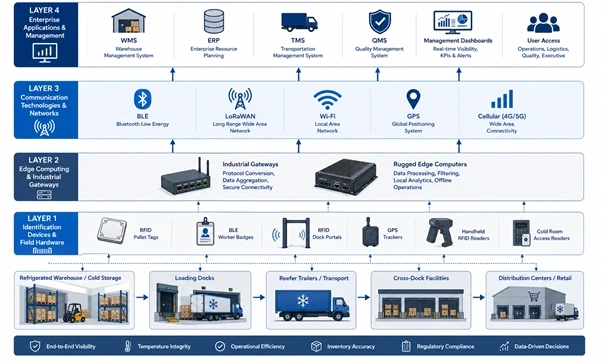
Every AI and IoT deployment consists of several complementary technology layers. Hardware provides the physical connection between operational activities and enterprise software by capturing identification events and transmitting operational information.
Identification Layer
RFID tags, employee badges, BLE beacons, GPS devices, and identification readers establish the digital identity of workers, pallets, trailers, reusable transport items, and mobile assets throughout refrigerated logistics operations.
Communication Layer
Wireless technologies including BLE, LoRaWAN, Wi-Fi, GPS, and cellular networks transport operational information between field devices and software applications while supporting both warehouse and transportation environments.
Computing Layer
Industrial gateways and edge computers coordinate local communications, buffer operational records, and securely exchange information with enterprise systems when communication networks become temporarily unavailable.
Enterprise Layer
Warehouse Management Systems (WMS), Transportation Management Systems (TMS), Enterprise Resource Planning (ERP), and Quality Management Systems (QMS) receive operational records collected by connected hardware and communication infrastructure.
Because each layer performs a specialized role, organizations can expand warehouse operations or transportation networks without replacing every component simultaneously.
Layered Hardware Technologies for AI and IoT in Cold Chain Logistics
This layered hardware diagram illustrates how identification devices, communication technologies, edge computing, and enterprise business systems work together across refrigerated logistics operations. It shows how RFID, BLE, GPS, industrial gateways, and rugged edge computers support data exchange with WMS, ERP, TMS, QMS, and management dashboards while maintaining operational visibility across refrigerated warehouses, loading docks, reefer trailers, cross-dock facilities, and distribution centers.
Cold Chain Reefer and Cold Room Hardware
Cold chain facilities require hardware capable of operating reliably across refrigerated warehouses, freezer rooms, pharmaceutical storage facilities, blast chillers, loading docks, and refrigerated transportation fleets. Equipment selection is influenced by environmental conditions, operational workflows, communication requirements, and installation locations.
Unlike traditional warehouse environments, refrigerated operations often involve condensation, frequent door openings, thermal cycling, vibration, and extended operating hours. Hardware must therefore support reliable communications while minimizing maintenance requirements.
Identification technologies form the foundation of warehouse visibility by allowing personnel, pallets, trailers, and reusable transport assets to be recognized automatically throughout logistics workflows.
Common hardware includes:
Industrial RFID readers
Handheld RFID terminals
Fixed dock portal readers
Vehicle-mounted readers
Badge readers
Industrial tablets
Rugged handheld computers
Mobile identification terminals
These devices support receiving, pallet staging, shipping verification, warehouse transfers, trailer loading, and distribution activities.
Controlled-access areas are common throughout refrigerated logistics operations, particularly in pharmaceutical storage, vaccine facilities, blast freezers, and high-value product warehouses.
Typical equipment includes:
RFID access readers
Smart badge readers
BLE credential readers
Industrial authentication terminals
Door access controllers
Vehicle gate readers
Personnel identification stations
Visitor authentication devices
These devices help organizations maintain secure access while supporting workforce accountability across multiple refrigerated facilities.
Industrial gateways and rugged edge computers coordinate communication between field devices and enterprise software. These systems aggregate operational events, manage local communications, and maintain data continuity during temporary network interruptions.
Typical hardware capabilities include:
Multi-protocol communication
Local event buffering
Industrial Ethernet connectivity
VPN support
Secure communication services
Edge data synchronization
Remote device management
High-availability operation
Edge equipment is commonly installed within warehouse communication rooms, distribution centers, cross-dock facilities, and transportation control centers to provide dependable operational connectivity.
Choosing hardware for refrigerated logistics requires balancing operational performance with long-term reliability.
Key considerations include:
Operating temperature range
Moisture and condensation resistance
Mechanical durability
Read distance requirements
Installation environment
Communication range
Power availability
Maintenance accessibility
Scalability for facility expansion
Compatibility with existing enterprise systems
Proper hardware selection helps organizations reduce maintenance requirements while improving identification accuracy and communication reliability throughout refrigerated logistics operations.
Applications Across Cold Chain Logistics
The hardware technologies introduced above support a broad range of refrigerated logistics operations where dependable identification and communication are essential.
Typical deployment environments include:
Pharmaceutical cold storage facilities
Vaccine distribution centers
Frozen food warehouses
Dairy product logistics operations
Seafood processing distribution
Fresh produce cold storage
Grocery fulfillment centers
Refrigerated cross-dock terminals
Reefer trailer staging yards
Third-party refrigerated logistics providers
Each environment presents unique operational requirements, making hardware selection a critical part of a successful AI and IoT deployment.
AI and RFID for Cold Chain Perishables
RFID is one of the most widely deployed identification technologies in cold chain logistics because it enables rapid, non-line-of-sight identification of pallets, reusable transport items, cases, containers, and shipping assets. Unlike manual barcode scanning, RFID allows multiple tagged items to be identified simultaneously while products move through receiving docks, cold rooms, staging areas, blast freezers, and shipping lanes.
Within ColdChainLog AI, RFID hardware provides the identification foundation that supports AI and IoT software, warehouse operations, transportation management, and enterprise business systems.
RFID Pallet Tags
RFID pallet tags provide a unique digital identity for pallets carrying pharmaceuticals, vaccines, frozen foods, dairy products, seafood, fresh produce, and other temperature-sensitive goods.
Typical deployment scenarios include:
Receiving verification
Warehouse put-away
Cross-dock transfers
Shipping confirmation
Trailer loading
Distribution center movements
Returnable transport item management
Pallet lifecycle tracking
Industrial RFID tags are selected according to operating temperatures, packaging materials, mounting methods, and expected reuse cycles to ensure dependable identification throughout refrigerated operations.
RFID Dock Portal Readers
Dock portal readers automatically capture pallet movements as shipments enter or leave refrigerated warehouses. Installed at loading bays, receiving docks, and transfer lanes, these readers eliminate many manual identification tasks while improving shipment visibility.
Common applications include:
Inbound shipment verification
Outbound shipment confirmation
Trailer loading validation
Cross-dock movement recording
Shipping manifest verification
Warehouse inventory updates
Carrier transfer documentation
Automated gate processing
Automated RFID identification improves throughput while reducing missed scans and manual data entry.
RFID Case and Container Labels
Many refrigerated products require traceability below the pallet level. RFID labels attached to insulated containers, reusable totes, cold cases, and product cartons provide granular identification throughout storage and transportation.
Typical applications include:
Pharmaceutical carton identification
Vaccine shipment tracking
Food case verification
High-value product management
Container return tracking
Mixed-load verification
Recall support
Distribution accuracy improvement
When integrated with enterprise software, RFID labels contribute to complete chain-of-custody records and improved inventory accuracy.
AI and BLE for Cold Chain Facilities
Bluetooth Low Energy (BLE) provides flexible short-range wireless communication within refrigerated warehouses, distribution centers, freezer rooms, and loading docks. BLE hardware is particularly useful for workforce location, proximity awareness, indoor asset identification, and zone-based operational workflows.
BLE devices consume minimal power while supporting continuous communication across large warehouse environments.
BLE-enabled wearable badges provide location awareness for personnel working in refrigerated facilities. Warehouse supervisors can better understand workforce distribution while supporting operational coordination and safety initiatives.
Typical uses include:
Personnel identification
Zone entry verification
Workforce location awareness
Emergency mustering support
Authorized area confirmation
Contractor identification
Visitor management
Shift activity documentation
These devices integrate with access control systems and workforce management software to improve operational accountability.
Cold storage operations frequently require awareness of personnel and equipment operating near restricted work areas, vehicle routes, freezer entrances, and loading docks.
BLE proximity hardware supports:
Cold vault proximity detection
Dock approach identification
Forklift interaction awareness
Equipment proximity management
Authorized work zone confirmation
Vehicle approach notification
Mobile workforce coordination
Indoor location services
These capabilities enhance operational coordination while supporting efficient warehouse workflows.
BLE zone tags establish virtual operational areas within refrigerated warehouses without extensive infrastructure modifications. Tags may be installed throughout freezer aisles, shipping lanes, dock doors, pallet staging areas, and vehicle routes.
Typical deployment locations include:
Freezer storage aisles
Blast chiller entrances
Dock staging zones
Loading lanes
Vehicle charging areas
Warehouse transfer corridors
High-value storage locations
Personnel assembly areas
The resulting location awareness supports workforce management, equipment utilization, and warehouse coordination.
AI and LoRaWAN for Cold Chain Storage
Large refrigerated logistics facilities often extend across multiple warehouses, outdoor trailer yards, distribution campuses, and remote storage locations. LoRaWAN offers long-range wireless communication with low power consumption, making it suitable for distributed cold chain operations.
Rather than replacing RFID or BLE, LoRaWAN complements them by providing wide-area connectivity between remote devices and centralized software.
Multi-Facility Communication
Organizations operating regional cold storage networks require communication that extends beyond individual buildings. LoRaWAN gateways support reliable information exchange across geographically dispersed facilities while reducing infrastructure complexity.
Typical deployments include:
Regional distribution campuses
Multi-building warehouse operations
Remote cold storage sites
Outdoor reefer parking areas
Trailer staging yards
Interconnected logistics centers
Bulk refrigerated storage facilities
Agricultural cold storage complexes
Wide-area communication improves operational consistency across distributed logistics operations.
LoRaWAN Gateways
Industrial LoRaWAN gateways collect communications from connected field devices and securely exchange operational information with enterprise software through wired or cellular backhaul connections.
Key capabilities include:
Long-range wireless communication
Multi-device connectivity
Secure message forwarding
Industrial network integration
Local communication buffering
Remote gateway administration
High device capacity
Reliable outdoor operation
LoRaWAN gateways are commonly installed at warehouse rooftops, logistics campuses, transportation terminals, and regional distribution centers where broad communication coverage is required.
Applications Across Refrigerated Logistics
RFID, BLE, and LoRaWAN hardware technologies complement one another by addressing different operational requirements within refrigerated logistics.
Representative applications include:
Pharmaceutical distribution centers requiring pallet identification and controlled workforce access.
Vaccine logistics facilities managing validated product movements.
Frozen food warehouses coordinating high-volume pallet handling.
Dairy distribution operations tracking reusable transport assets.
Fresh produce logistics centers managing warehouse flows.
Seafood cold storage facilities improving shipment traceability.
Grocery fulfillment centers coordinating indoor workforce movement.
Regional refrigerated warehouse networks connecting multiple storage facilities.
Cross-dock transfer hubs handling rapid inbound and outbound freight.
Third-party logistics providers supporting diverse customer requirements.
Combining these technologies enables organizations to build scalable AI and IoT solutions that improve operational visibility while maintaining dependable identification and communication across complex refrigerated logistics environments.
Why Connectivity Choice Depends on the Specific Cold Chain Zone
Cold chain logistics environments present different operational challenges depending on location, product type, handling frequency, and regulatory requirements. A single wireless technology rarely provides optimal performance across refrigerated warehouses, freezer rooms, blast chillers, cross-dock facilities, and refrigerated transportation. Selecting the appropriate identification, communication, and location technology for each operational zone improves reliability, minimizes infrastructure costs, and supports accurate decision-making throughout the cold chain.
ColdChainLog AI recommends matching hardware technologies to operational objectives instead of deploying identical devices throughout every facility. RFID, BLE, LoRaWAN, GPS, and cellular communication each solve different identification and location challenges while supporting AI and IoT software and enterprise systems.
Typical technology selection includes:
RFID for pallet identification at dock doors, shipping lanes, receiving stations, and warehouse checkpoints.
BLE for workforce location awareness, forklift positioning, restricted area proximity, and mobile asset identification.
LoRaWAN for long-range communication across large refrigerated warehouses, distribution campuses, and outdoor storage yards.
GPS for monitoring refrigerated trailers operating across regional or international transportation routes.
Cellular communication for continuous connectivity between moving refrigerated assets and enterprise software.
Hybrid communication models where multiple wireless technologies work together throughout the logistics process.
Matching communication technology to each operational area reduces unnecessary infrastructure, improves data quality, increases read reliability, and simplifies future expansion.
Applications Across Cold Chain Logistics
ColdChainLog AI hardware supports identification and location workflows across numerous refrigerated logistics environments where product integrity, traceability, and regulatory compliance are operational priorities.
Common deployment environments include:
Pharmaceutical cold storage facilities
Vaccine distribution centers
Frozen food manufacturing warehouses
Seafood and meat processing distribution
Dairy product logistics
Fresh produce distribution hubs
Grocery fulfillment centers
Temperature-controlled third-party logistics providers
Cross-docking operations
Import and export cold storage terminals
Airport pharmaceutical logistics
Port-based refrigerated container yards
Retail distribution centers
Refrigerated trucking fleets
Last-mile cold delivery operations
Each environment has unique movement patterns, throughput requirements, storage conditions, and compliance obligations. Selecting the correct hardware for each operational zone helps maintain continuous product visibility while supporting GDP, HACCP, FSMA, and customer-specific traceability requirements.
Supporting AI and IoT Software Across the Cold Chain
Physical hardware provides the identification and communication foundation required for AI and IoT software to deliver meaningful operational insights. RFID readers identify pallets, BLE beacons determine worker and equipment locations, GPS devices report fleet movement, and communication gateways transfer operational data to enterprise software.
Rather than operating independently, these hardware technologies support software responsible for:
Asset identification
Worker authorization
Location verification
Inventory synchronization
Shipment visibility
Chain-of-custody recording
FEFO inventory workflows
Compliance documentation
Exception management
Predictive operational analytics
AI models then evaluate historical identification records, equipment movement, operational events, and logistics workflows to assist planners in improving warehouse efficiency, reducing handling delays, identifying bottlenecks, and maintaining product integrity throughout refrigerated transportation.
This separation between hardware, IoT software, AI models, and enterprise integration simplifies system maintenance while allowing organizations to upgrade individual components without redesigning the complete solution.
Best Wireless Technology for Each Cold Chain Logistics Operation
❄️ Supplier Receiving & Goods Acceptance
🧊 Cold Storage Warehouse
🚪 Freezer Rooms & Restricted Cold Areas
🚚 Loading Docks & Dispatch Areas
🚛 Reefer Trailer Operations
🔄 Cross-Dock Transfer Facilities
🏥 Pharmaceutical Distribution Centers
🛒 Grocery Distribution Centers
🌍 Multi-Site Cold Storage Networks
🚢 Port Cold Storage & Intermodal Logistics
Why Organizations Choose ColdChainLog AI
ColdChainLog AI combines practical industrial experience with enterprise AI and IoT expertise to help organizations modernize refrigerated logistics using proven identification and location technologies.
Built within Aperture Venture Studio with support from GAO, the company benefits from more than two decades of IoT experience gained through thousands of customer deployments across industrial logistics environments. Continuous investment in engineering, quality assurance, and applied research enables ColdChainLog AI to deliver reliable solutions for demanding cold chain operations.
Engineering teams include experienced specialists and Ph.D. professionals who understand enterprise wireless communications, RFID identification, industrial networking, AI software, and logistics automation. Remote and onsite technical support assists customers throughout planning, deployment, optimization, and long-term operation.
Solutions developed through these real-world engagements have supported organizations ranging from Fortune 500 manufacturers and logistics providers to research institutions and government agencies across North America.
Relevant U.S. and Canadian Standards and Regulations for AIoT-Enabled Cold Chain Logistics
The following standards and regulations are commonly applicable to AI-enabled identification, location, asset tracking, inventory management, workforce access, traceability, and cold chain operations within Industrial Logistics & Supply Chain environments.
Food Safety and Cold Chain
FDA Food Safety Modernization Act (FSMA)
FDA 21 CFR Part 11
FDA 21 CFR Part 117
FDA Sanitary Transportation Rule (21 CFR Part 1, Subpart O)
USDA Food Safety and Inspection Service (FSIS)
HACCP (Hazard Analysis and Critical Control Points)
Codex Alimentarius HACCP Guidelines
Safe Quality Food (SQF) Code
BRCGS Global Standard for Food Safety
Canada Safe Food for Canadians Regulations (SFCR)
Safe Food for Canadians Act (SFCA)
Canadian Food Inspection Agency (CFIA) Regulations
Pharmaceutical Cold Chain
FDA Current Good Manufacturing Practice (cGMP)
FDA 21 CFR Parts 210 and 211
Good Distribution Practice (GDP)
USP <1079> Good Storage and Distribution Practices
Health Canada GUI-0069 Good Manufacturing Practices
Health Canada Good Distribution Practices
EU GDP Guidelines (commonly adopted globally)
RFID, Identification, and Automatic Data Capture
GS1 General Specifications
GS1 EPCglobal Standards
EPC Gen2 (ISO/IEC 18000-63)
ISO/IEC 18000 Series
ISO/IEC 15459
ISO/IEC 15416
ISO/IEC 15415
ISO/IEC 15961
ISO/IEC 15962
Asset Identification and Supply Chain
ISO 17363
ISO 17364
ISO 17365
ISO 17366
ISO 17367
ISO 28219
Quality Management
ISO 9001
ISO 22000
FSSC 22000
ISO 28000
ISO 31000
Information Security and Cybersecurity
ISO/IEC 27001
ISO/IEC 27002
IEC 62443 Series
NIST Cybersecurity Framework (CSF)
NIST SP 800-53
NIST SP 800-82
NIST AI Risk Management Framework (AI RMF)
Wireless Communications
FCC Part 15
ISED RSS Standards (Canada)
Bluetooth SIG Specifications
LoRa Alliance LoRaWAN Specification
IEEE 802.11
IEEE 802.3
3GPP LTE Standards
3GPP 5G Standards
Industrial Communications
OPC UA (IEC 62541)
MQTT (ISO/IEC 20922)
Modbus TCP
EtherNet/IP
PROFINET
Occupational Safety
OSHA 29 CFR 1910
OSHA Powered Industrial Truck Standard
CSA Z1000
CSA Z1002
ANSI/ASSP Z244.1
Leading Companies Supporting AIoT-Enabled Cold Chain Logistics
The following organizations are recognized for technologies used across AI and IoT identification, RFID, BLE, location systems, industrial mobility, warehouse automation, refrigerated transportation, and cold chain logistics.
RFID and Identification Solutions
Zebra Technologies
Honeywell
Impinj
Avery Dennison
SATO
HID Global
Brady Corporation
Identiv
Checkpoint Systems
CAEN RFID
Industrial Mobile Computing
Zebra Technologies
Honeywell
Datalogic
CipherLab
Bluebird
Newland AIDC
Unitech Electronics
Chainway
BLE and Real-Time Location
Kontakt.io
Quuppa
HID Global
Minew
BlueCats
Cisco Spaces
Industrial Networking and Connectivity
Cisco
HPE Aruba Networking
Siemens
Moxa
Advantech
Digi International
Teltonika Networks
MultiTech
📡 LoRaWAN Solutions
Semtech
Kerlink
MultiTech
Milesight
TEKTELIC Communications
Loriot
Actility
GPS and Fleet Technologies
Geotab
Samsara
ORBCOMM
CalAmp
Verizon Connect
Motive
Trimble Transportation
Warehouse and Supply Chain Software
Manhattan Associates
Blue Yonder
Körber Supply Chain
SAP
Oracle
Infor
Tecsys
Softeon
Cold Chain Logistics Technology
Sensitech
Controlant
Tive
Copeland
Carrier Transicold
Thermo King
ORBCOMM
Emerson
Industrial Automation
Siemens
Rockwell Automation
Schneider Electric
ABB
Mitsubishi Electric
Omron
Beckhoff Automation
Bosch Rexroth
Cloud and AI Technologies
Microsoft
Google Cloud
Amazon Web Services (AWS)
IBM
NVIDIA
Intel
Why ColdChainLog AI
ColdChainLog AI applies AI and IoT technologies to identification, location, access management, refrigerated asset visibility, inventory control, and traceability throughout cold chain logistics. Rather than focusing solely on monitoring conditions, the company emphasizes RFID, BLE, GPS, LoRaWAN, cellular communications, and enterprise identification solutions that improve operational visibility across refrigerated warehouses, distribution centers, cross-dock facilities, pharmaceutical storage, grocery fulfillment centers, and refrigerated transportation fleets.
Created within Aperture Venture Studio with support from GAO, ColdChainLog AI benefits from more than two decades of IoT experience gained through thousands of successful deployments across industrial logistics environments. Extensive investment in research and development, rigorous quality assurance, experienced engineering teams, and remote or onsite technical support enables organizations to deploy reliable AIoT solutions with confidence. The company is supported by Ph.D. professionals, strategic industry partners, and extensive experience serving Fortune 500 companies, leading research organizations, universities, and government agencies throughout the United States and Canada.
Case Studies
Chicago, Illinois, USA
A large refrigerated distribution center handling frozen foods and temperature-controlled consumer products experienced operational inefficiencies caused by limited visibility into pallet movement, restricted-area access, forklift traffic, and workforce location throughout multiple freezer zones.
The organization managed thousands of pallet movements each day between receiving docks, blast freezing areas, high-density storage racks, staging lanes, and outbound shipping docks. Manual barcode scanning created delays during receiving and shipping, while pallet searches increased labor requirements. Warehouse supervisors also needed improved visibility into forklift activity inside restricted freezer areas to reduce congestion and improve operational safety.
Access management for controlled freezer vaults relied on traditional credentials that provided limited correlation between personnel movement and pallet handling activities. Management also sought improved traceability for FEFO inventory rotation without increasing manual data entry.
ColdChainLog AI, supported by GAO, designed an AI and IoT identification and location solution focused on RFID-based pallet identification, BLE-based workforce location, and AI-assisted workflow optimization while preserving existing warehouse management software.
SolutionOur engineering team developed an integrated AIoT solution centered on identification and location technologies rather than manual transaction recording.
The deployment included:
GAO RFID UHF RFID Readers installed at receiving lanes, dock doors, freezer entrances, and outbound shipping areas.
GAO RFID UHF RFID Tags attached to reusable pallets and logistics containers designed for refrigerated warehouse operations.
GAO RFID RFID Antennas optimized for portal reading within high-density pallet traffic lanes.
GAO Tek BLE Beacons assigned to warehouse associates and forklift operators.
GAO Tek BLE Gateways positioned throughout freezer aisles, staging lanes, loading docks, and restricted warehouse sections.
GAO Tek Device Edge Computing equipment performing local event filtering and RFID transaction validation before forwarding operational records to enterprise software.
AI software correlated RFID movement history, BLE location events, authorized access records, pallet dwell duration, forklift travel paths, and shipping schedules.
Rather than simply recording pallet identification events, AI models identified operational patterns including:
Repeated pallet searches
Extended pallet dwell time
Forklift congestion
Unauthorized entry attempts
Delayed shipping preparation
FEFO rotation deviations
Repetitive warehouse travel paths
Our implementation also synchronized RFID transactions with warehouse software so inventory records reflected verified pallet movement instead of manual confirmation.
BLE location events enabled supervisors to review workforce movement history while maintaining operational awareness across multiple freezer rooms.
The solution supported future expansion into additional refrigerated facilities using the same RFID and BLE infrastructure.
ResultPallet search time decreased by approximately 47% following RFID automation.
Manual pallet identification events were significantly reduced during receiving and shipping operations.
FEFO inventory verification became substantially more consistent because pallet identification occurred automatically at operational checkpoints.
Forklift travel patterns became easier to optimize through AI-assisted route analysis.
Restricted freezer access records became electronically correlated with pallet handling history.
Warehouse supervisors gained improved visibility into workforce movement throughout refrigerated storage operations.
Inventory reconciliation required fewer manual verification activities.
The most significant measurable outcome was a 47% reduction in pallet search time, allowing warehouse personnel to process outbound orders more efficiently during peak shipping periods.
Lesson LearnedIdentification technologies provide the greatest operational value when RFID, BLE, and AI software work together. Automating pallet identification alone improves inventory visibility, but combining workforce location, access management, and AI analysis enables organizations to optimize complete warehouse workflows instead of individual transactions.
Dallas, Texas, USA
A regional refrigerated transportation organization operating temperature-controlled trailers across multiple distribution centers required improved visibility into trailer utilization, shipping assets, yard operations, and driver movement.
Dispatch personnel frequently experienced delays locating refrigerated trailers awaiting loading or unloading. Yard personnel manually documented trailer arrivals, departures, and staging locations, resulting in inconsistent equipment utilization records and delayed shipment processing.
Warehouse operations also required stronger traceability between outbound pallets, refrigerated trailers, loading docks, and authorized personnel responsible for shipment preparation.
The organization wanted improved fleet visibility while maintaining compatibility with existing transportation management software and warehouse operations.
ColdChainLog AI worked with GAO to design an AI and IoT solution emphasizing identification, location awareness, and asset visibility across both warehouse and transportation environments.
SolutionThe deployment combined multiple wireless technologies selected according to operational requirements throughout refrigerated logistics operations.
Hardware deployed included:
GAO Tek GPS IoT Trackers installed on refrigerated trailers.
GAO Tek Cellular IoT Devices providing continuous wide-area communications throughout transportation routes.
GAO RFID UHF RFID Readers deployed at shipping docks and trailer loading lanes.
GAO RFID UHF RFID Tags assigned to reusable logistics assets and outbound pallet units.
GAO Tek BLE Beacons carried by yard personnel and assigned to critical mobile equipment.
GAO Tek BLE Gateways installed around trailer parking zones, dispatch offices, maintenance facilities, and loading areas.
GAO Tek Device Edge Computing systems validating RFID reads before enterprise synchronization.
AI software correlated trailer arrival history, RFID loading confirmation, GPS location, BLE workforce movement, loading duration, dock utilization, and dispatch scheduling.
The solution supported:
Automated trailer identification
Yard asset visibility
Driver and workforce location awareness
Loading dock utilization analysis
Trailer assignment verification
Shipment traceability
Inventory transfer validation
Chain-of-custody recording
AI software continuously evaluated historical loading activity to identify recurring operational delays, inefficient trailer assignments, prolonged yard dwell time, and bottlenecks affecting outbound shipment preparation.
GPS and cellular communication provided continuous trailer location updates during transportation while RFID confirmed asset identity during loading and unloading activities.
BLE location information enabled supervisors to coordinate yard operations more efficiently by identifying personnel assigned to trailer movement and shipment preparation.
ResultAverage trailer search time across yard operations decreased by approximately 41%.
Trailer assignment verification became substantially faster through automated identification.
Loading documentation required fewer manual updates.
Outbound shipment traceability improved from warehouse staging through transportation.
Yard congestion became easier to identify using AI-assisted movement analysis.
Dispatch planning improved through more accurate trailer availability records.
Warehouse and transportation software maintained synchronized asset identification records throughout shipment processing.
The most significant measurable improvement was a 41% reduction in trailer search time, allowing dispatch teams to increase trailer utilization while reducing delays during refrigerated shipment scheduling.
Lesson LearnedCold chain logistics requires different wireless technologies for different operational environments. GPS and cellular communications support transportation visibility, while RFID and BLE provide precise identification and workforce location within distribution facilities. Combining these technologies through AI and IoT software produces greater operational benefits than relying on any single communication method alone.
Vancouver, British Columbia, Canada
A pharmaceutical cold chain distribution organization operating across British Columbia required stronger control over serialized medicine shipments, validated refrigerated storage, and regulated custody transfers between regional warehouses, airport cargo facilities, and healthcare delivery locations. Manual barcode verification created delays during receiving and dispatch while limited visibility into refrigerated pallet movements complicated compliance with GDP and internal quality procedures. ColdChainLog AI worked with GAO Tek Inc. and GAO RFID Inc. to deploy an AI and IoT identification and location solution focused on RFID-based traceability, controlled access, inventory verification, and refrigerated asset tracking while protecting confidential customer information.
ProblemThe organization managed thousands of temperature-sensitive pharmaceutical shipments every week through refrigerated warehouses, cross-dock operations, and reefer transportation. Warehouse personnel relied heavily on manual pallet identification during receiving, put-away, picking, loading, and custody transfers.
Operational challenges included:
Delayed pallet identification during receiving.
Manual verification of serialized pharmaceutical shipments.
Limited visibility of refrigerated pallet movements.
Difficulty demonstrating chain of custody during audits.
Inefficient FEFO inventory verification.
Restricted visibility into authorized personnel movement inside controlled storage areas.
Time-consuming reconciliation between warehouse records and shipment documentation.
ColdChainLog AI implemented an AI and RFID identification and location solution integrating warehouse operations, refrigerated logistics, and pharmaceutical compliance workflows.
The deployment included:
AI-assisted RFID pallet identification.
RFID dock portal verification.
RFID custody handoff recording.
BLE personnel location support.
Role-based cold vault access verification.
AI-assisted inventory reconciliation.
Warehouse geofencing for authorized staff movement.
Enterprise software synchronization with warehouse management applications.
GAO RFID Inc. supplied UHF RFID readers, dock portal readers, RFID antennas, RFID reader modules, and pharmaceutical-grade RFID labels suitable for refrigerated warehouse operations.
GAO Tek Inc. provided BLE gateways, BLE beacons, industrial edge computing devices, and Cellular IoT communication equipment supporting distributed warehouse operations.
AI models continuously evaluated RFID event history to identify missing pallet movements, duplicate shipment scans, custody inconsistencies, and warehouse workflow anomalies requiring operator review.
Relevant GAO Tek and GAO RFID Hardware UsedGAO RFID UHF Readers
GAO RFID UHF Pallet Tags
RFID Dock Portal Readers
RFID Antennas
RFID Reader Modules
BLE Gateways
BLE Beacons
Cellular IoT Devices
Device Edge Computing Systems
These technologies enabled reliable identification throughout refrigerated warehouse operations while minimizing manual data entry.
Technical ImplementationReceiving docks automatically identified arriving pharmaceutical pallets using RFID portal readers before warehouse personnel unloaded shipments.
BLE location services verified authorized personnel movement into controlled refrigerated zones.
AI and RFID software validated shipment identity against warehouse orders before inventory acceptance.
Warehouse operators used handheld RFID readers for rapid exception handling whenever discrepancies appeared during receiving or dispatch.
Custody transfers automatically generated electronic event records supporting GDP documentation requirements.
Device edge computing synchronized RFID transactions locally before securely forwarding validated records to enterprise software.
AI software continuously reviewed movement history to identify duplicate scans, missed custody events, unauthorized pallet movement, and incomplete shipping documentation.
ResultFollowing implementation, warehouse operations achieved measurable improvements.
Receiving verification time reduced by 39%.
Inventory reconciliation effort reduced by 42%.
Manual custody documentation reduced by 58%.
Shipment verification accuracy exceeded 99%.
Audit preparation time significantly decreased.
The most significant measurable outcome was a 39% reduction in receiving verification time across refrigerated pharmaceutical distribution operations.
Lesson LearnedHighly regulated pharmaceutical logistics benefit most when RFID identification, controlled access, warehouse software, and AI-assisted validation operate together rather than independently. Reliable electronic custody records substantially reduce compliance workloads while improving operational transparency.
Minneapolis, Minnesota
A large frozen food distribution network supporting regional grocery chains sought improved workforce visibility, forklift coordination, refrigerated pallet identification, and controlled facility access across multiple freezer warehouses. Existing manual procedures limited visibility into worker movement, delayed pallet verification, and increased congestion around loading docks during peak outbound shipping periods. ColdChainLog AI, supported by GAO Tek Inc. and GAO RFID Inc., implemented an AI and IoT solution combining BLE location services, RFID identification, and enterprise warehouse software integration while maintaining customer confidentiality.
ProblemDaily operations involved thousands of pallet movements through freezer storage, blast freezing rooms, staging lanes, and outbound loading docks.
Operational challenges included:
Limited visibility of forklift traffic inside freezer zones.
Manual pallet identification during outbound loading.
Restricted monitoring of authorized personnel inside controlled refrigerated areas.
Delayed investigation of misplaced frozen inventory.
Warehouse congestion during shipping peaks.
Slow reconciliation between physical inventory and warehouse software.
Inconsistent visibility across multiple freezer facilities.
ColdChainLog AI deployed an integrated AI and IoT identification and location solution supporting warehouse operations.
Key solution components included:
BLE workforce location services.
RFID pallet identification.
AI-assisted pallet movement validation.
Dock door verification.
Warehouse geofencing.
Controlled freezer room access.
AI-supported inventory reconciliation.
Fleet movement analysis for warehouse vehicles.
GAO Tek Inc. supplied BLE gateways, BLE worker beacons, edge computing equipment, and Cellular IoT communication devices supporting distributed refrigerated warehouse operations.
GAO RFID Inc. supplied UHF RFID readers, handheld RFID readers, RFID dock portals, RFID antennas, and reusable pallet tags designed for repeated freezer handling.
Machine learning software analyzed warehouse movement history to detect inefficient travel paths, repeated loading delays, pallet congestion, and unauthorized inventory movement while supporting continuous operational improvement.
Relevant GAO Tek and GAO RFID Hardware UsedBLE Worker Beacons
BLE Gateways
UHF RFID Readers
RFID Dock Portal Readers
Handheld RFID Readers
RFID Antennas
RFID Pallet Tags
Cellular IoT Devices
Device Edge Computing Systems
These hardware categories enabled reliable workforce positioning, pallet identification, and refrigerated warehouse visibility.
Technical ImplementationBLE beacons assigned to warehouse employees continuously interacted with gateway infrastructure to provide authorized location awareness throughout refrigerated operations.
RFID dock portals automatically confirmed outbound pallet identity before loading refrigerated trailers.
Forklift operators used handheld RFID readers for exception handling and inventory verification.
Edge computing systems processed RFID events locally to reduce communication delays during busy shipping periods.
AI software correlated workforce movement, pallet identification, loading activity, and warehouse task completion to identify workflow bottlenecks and recommend operational improvements.
Warehouse software maintained synchronized inventory records while documenting all authorized custody events.
ResultOperational performance improved following deployment.
Outbound shipment verification improved by 46%.
Time required to locate misplaced pallets reduced by 52%.
Manual inventory verification reduced by 41%.
Loading dock congestion reduced by 27%.
Warehouse inventory accuracy exceeded 99%.
The primary measurable outcome was a 52% reduction in time required to locate misplaced refrigerated pallets across freezer warehouse operations.
Lesson LearnedCold chain distribution benefits from combining BLE workforce visibility with RFID pallet identification rather than relying on either technology independently. AI-assisted analysis of warehouse movement patterns improves operational efficiency while preserving accurate inventory records, controlled access, and regulatory compliance throughout refrigerated logistics.
Building Reliable Cold Chain Operations with AI and IoT
Reliable cold chain operations depend on selecting hardware that matches environmental conditions, operational workflows, regulatory obligations, and business objectives. RFID, BLE, LoRaWAN, GPS, and cellular technologies each contribute unique capabilities for identifying assets, locating personnel, tracking refrigerated shipments, and maintaining visibility throughout temperature-controlled logistics.
ColdChainLog AI helps organizations evaluate these technologies within the context of their facilities, transportation networks, and enterprise software, ensuring that hardware deployments support long-term operational efficiency while providing a strong foundation for AI and IoT applications, inventory management, compliance reporting, and refrigerated supply chain optimization.
Whether modernizing a pharmaceutical warehouse, expanding refrigerated fleet visibility, improving pallet traceability, or strengthening food safety compliance, ColdChainLog AI delivers hardware solutions designed specifically for demanding cold chain logistics environments.
Contact Us